PSI is a unit of pressure, while PSIG is gauge pressure measured against atmospheric pressure. This difference matters because PSI can be unclear on its own. PSIG is the clear gauge reading, so you always know what the number is based on. The psi vs psig question comes up often in daily work with compressed air, tires, and hydraulic lines. This post gives you clear definitions, the difference between PSI, PSIA, and PSIG, practical uses for each, and conversion formulas. You will also find a reference table for common units. Keep these ideas handy the next time a gauge or a data sheet leaves you guessing.
Key Takeaways
PSI is a general unit for pressure. It does not say what the reference point is.
PSIG measures pressure compared to the air around it. It shows zero at normal air pressure.
PSIA measures pressure compared to a perfect vacuum. It counts atmospheric pressure in the reading.
To change PSIG to PSIA, add the local air pressure (about 14.7 PSI at sea level).
Use PSIG for everyday jobs like checking tire pressure. Use PSIA for vacuum work and gas math.
Understanding PSI, PSIA, and PSIG
PSI as a General Unit
PSI stands for pounds per square inch. It is a common unit for measuring pressure. You will find it on tire sidewalls, air compressor labels, and hydraulic system specs. The unit shows how much force is spread over one square inch of area.
PSI is not always clear. It can mean absolute or gauge pressure, depending on the situation. A data sheet may list "100 psi" and give no other detail. That number means little until you know the reference point behind it. Understanding PSI, PSIA, and PSIG starts with this unclear point. The unit alone does not tell you which scale the reading uses.
PSIA and PSIG Defined
PSIA means pounds per square inch absolute. This scale measures pressure against a perfect vacuum. Absolute pressure includes the local atmospheric pressure in its reading. A vessel at sea level with no added air still reads about 14.7 PSIA.
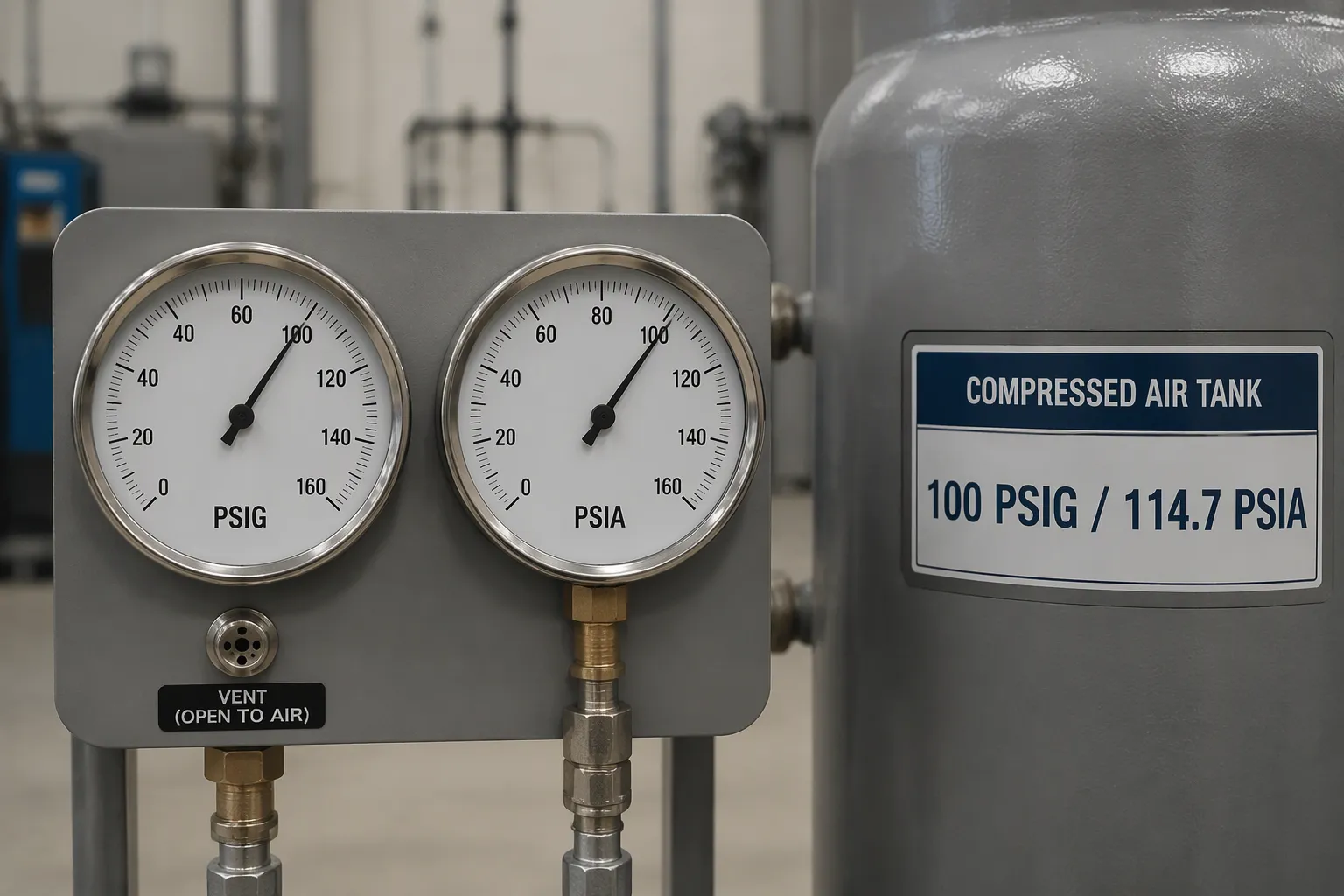
PSIG means pounds per square gauge. This scale measures pressure compared to the surrounding atmospheric pressure. You can also call it gauge pressure referenced to the atmosphere. A vented tank reads zero PSIG, even though the air inside still pushes outward. Most pressure gauges read in PSIG. The needle sits at zero at ambient atmospheric pressure, so the dial shows only the pressure above the surrounding air.
The two scales share one unit but use different zero points. That one fact explains almost every confusion between them. A gauge pressure reading and an absolute pressure reading of the same system will never match. The gap equals the local atmospheric pressure at your site.
PSI vs PSIG: Key Differences
Reference Point and Reading Interpretation
The main difference between these scales is where zero starts. A PSIG reading begins at the air pressure around you. A PSIA reading begins at a perfect vacuum. This one choice of reference point changes every number on the dial. That choice also shapes how you read a value in the field. A gauge and an absolute sensor on the same pipe will show different numbers, and both are right.
PSIG is always lower than PSIA for the same system. The gap equals the local air pressure. At sea level, that gap is about 14.7 PSI. A tank that reads 100 PSIG actually holds about 114.7 PSIA. The gauge ignores the weight of the air above it. The absolute scale counts that air pressure as part of the total. A vented tank shows zero on a gauge dial, yet its absolute pressure still sits near 14.7 PSIA. Both readings describe the same air. They just start counting from different reference points.
You will often see PSI used alone in casual settings. A mechanic may say "32 psi" for a tire. A compressor label may list "90 psi." In both cases, the speaker means gauge pressure. This informal habit works fine in daily talk. That habit saves time, but it leaves room for error when the stakes rise. The trouble starts when a document mixes scales without a clear reference. A value of 50 PSI could mean 50 PSIG or 50 PSIA. Those two readings differ by roughly 14.7 PSI. That gap can matter a great deal in a vacuum chamber or a gas law calculation. A sealed vessel rated for 50 PSIA will fail long before a 50 PSIG rating suggests.
The psi vs psig distinction protects you from this trap. Always check the pressure reference before you trust a number. A clear label removes the guesswork. The fundamental differences between psi, psia, and psig all trace back to that reference point. Once you know where zero sits, the rest follows.
Comparison Table
The table below sums up the three scales. Use it as a quick reference when you read a spec sheet or a gauge face.
Scale
Definition
Reference Point
Typical Use
Relationship to Atmospheric Pressure
PSI
General pressure unit
Unclear on its own
Informal talk, general labels
May mean either scale
PSIG
Gauge-referenced unit
Ambient atmospheric pressure
Tires, air lines, hydraulics
Reads zero at ambient conditions
PSIA
Absolute-referenced unit
Perfect vacuum
Vacuum work, gas calculations
Includes atmospheric pressure in the reading
The psig vs psia row shows the clearest split. True gauge pressure sits at zero when the vessel vents to open air. Absolute pressure never drops to zero unless you reach a full vacuum. Keep this table nearby for a fast check. It turns a confusing label into a clear reading. A quick glance at the reference column tells you which scale you hold. The psi vs psig split is really a question of where zero sits.
Difference Between PSI, PSIA, and PSIG in Practice
When to Use PSIG
You use PSIG when a gauge compares a system to the air around it. Tire pressure is the classic example. A tire filled to 32 PSIG holds about 14.7 PSI more than the surrounding air. The gauge reads zero before you add air, so the number shows exactly how much extra push you added. Compressed air lines work the same way. A shop line running at 90 PSIG gives you a clear idea of usable push above the surrounding air. Hydraulic systems also depend on this scale. A hydraulic press rated at 2,000 PSIG shows the working load above the surrounding air. Technicians trust these readings because the gauge and the task start from the same zero point.
True gauge pressure fits any job where the surrounding air stays about the same. You care about the added push, not the total. A pressure washer, a spray gun, or a pneumatic tool all work based on that added push. The gauge gives you a direct, practical number. This is why most dial gauges in daily use read in PSIG.
When to Use PSIA
You switch to PSIA when the surrounding air becomes part of the problem. Vacuum systems are the clearest example. A chamber pulled down to 5 PSIA still holds some gas, and that absolute value tells you how much is left. A gauge reading would show a negative number and make things confusing. Work that changes with altitude also calls for absolute pressure. A balloon launched from a mountain top starts with lower local atmospheric pressure than one launched at the coast. Gas law calculations always need absolute pressure. The ideal gas law relates pressure, volume, and temperature on an absolute scale. If you plug in a gauge value, your result will be wrong.
The difference between psi, psia and psig becomes clear once you match the scale to the task. Use PSIG for everyday equipment checks. Use PSIA for vacuum work, altitude studies, and any gas calculation. Each scale fits its own job well. The correct pressure reference keeps your numbers honest.
PSIG vs PSIA: Calculations for PSI, PSIG, PSIA
PSIG to PSIA Formula
The math behind these two scales is simple. You add the local atmospheric pressure to a gauge reading to get an absolute reading. At sea level, that value is about 14.7 PSI. The standard relation reads psia = psig + 1 atm, where 1 atm stands for the local atmospheric pressure at your site. The reverse relation reads psig = psia - 1 atm. You subtract the same atmospheric pressure to return to a gauge value.
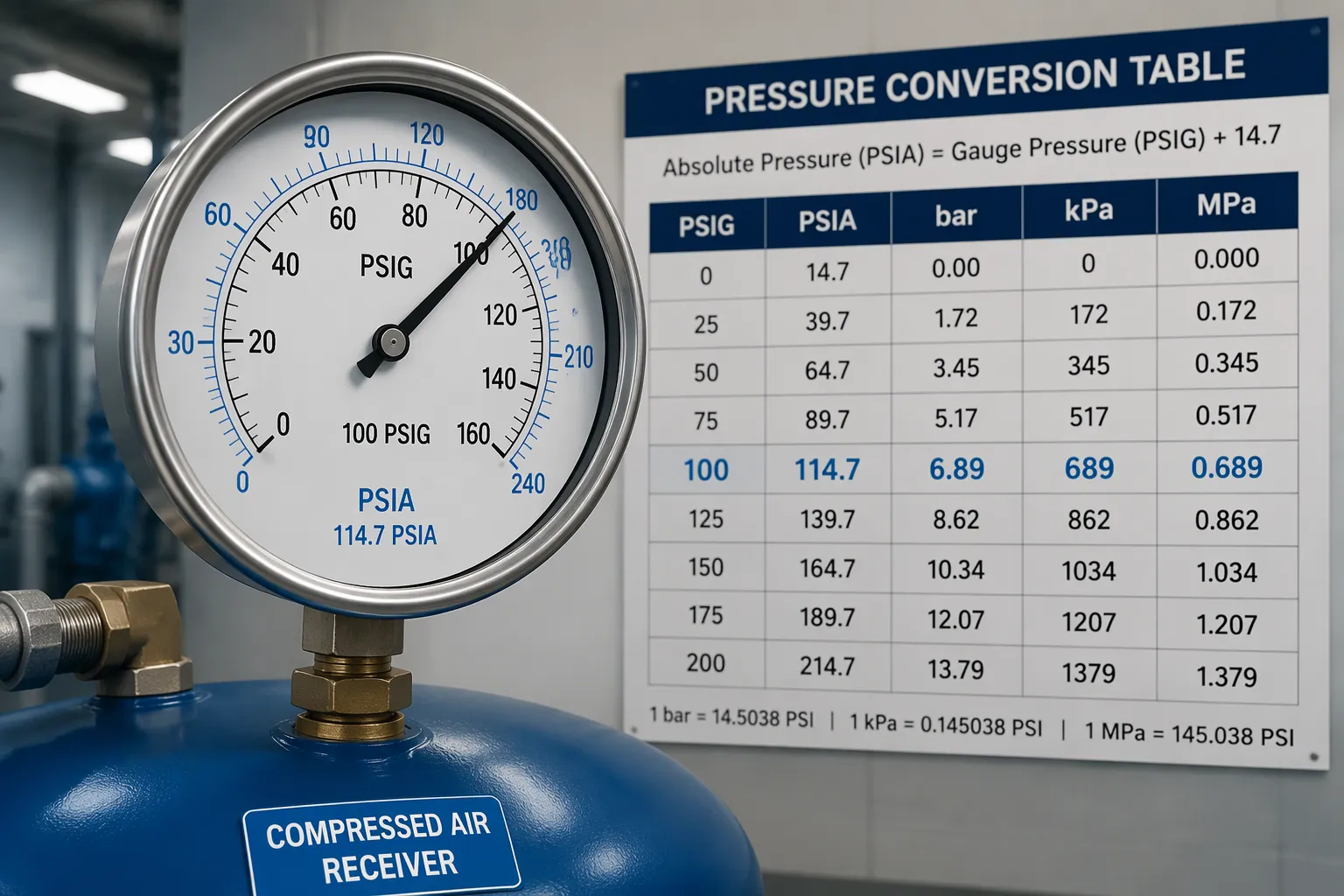
A worked example makes this concrete. Suppose a compressed air receiver shows 100 PSIG on its dial. Add 14.7 PSI of atmospheric pressure. The absolute pressure inside the tank is 114.7 PSIA. Now reverse it. A vacuum chamber reads 5 PSIA. Subtract 14.7 PSI. The gauge value is -9.7 PSIG, a negative number that shows the chamber sits below the surrounding air. This psia-to-psig calculation works the same way in both directions. The only input that changes is the local atmospheric pressure. A site high in the mountains has a lower value than a coastal plant, so check your site value before you convert between psia and psig.
Conversion Table for Common Units
The table below gives you a fast conversion reference. Each row starts from one common pressure value and shows the matching reading on the other scales. The PSIG and PSIA columns assume sea level, where atmospheric pressure is about 14.7 PSI. The bar, kPa, and MPa columns follow the standard unit relations, with 1 bar equal to 100 kPa and 0.1 MPa.
PSI (general)
PSIG
PSIA
bar
kPa
MPa
0
0
14.7
1.013
101.3
0.101
14.7
14.7
29.4
2.027
202.7
0.203
100
100
114.7
7.9
790
0.79
Read the table with the pressure reference in mind. The first row shows a vented vessel. The gauge reads zero, yet the absolute pressure still sits near one atmosphere. The second row doubles the gauge value, and the absolute value rises by the same amount. The third row matches the worked example above.
These calculations for psi, psig, psia stay reliable as long as you track the reference point. A gauge pressure reading always needs the atmospheric pressure added before you use it in a gas law. An absolute pressure reading always needs that same value subtracted before you compare it to a dial. Keep the two formulas and this table close at hand. They turn a psig vs psia question into a quick, confident answer.
Pounds per square inch is the unit, PSIG is the gauge-referenced scale, and PSIA is the absolute scale. That reference point answers most psi vs psig questions you will meet. Choose PSIG for tires, air lines, and hydraulics, where you care about pressure above the surrounding air. Choose PSIA for vacuum work, altitude studies, and gas law math, where absolute pressure drives the result.
Keep the conversion formulas and the table nearby as a quick reference for daily checks. Add local atmospheric pressure to a PSIG reading to reach PSIA, and subtract the atmospheric pressure to go back. Match the reference to the job, and your gauge pressure numbers will tell the truth.
FAQ
What does the "G" in PSIG stand for?
The "G" stands for gauge. A psig reading uses the air around you as its zero reference. The dial shows only the pressure above that surrounding air. This reference keeps field readings simple and direct.
Why does a gauge read zero when a tank is full of air?
A vented tank holds air at the same pressure as the room. The gauge uses that room air as its reference, so the needle rests at zero. The tank still holds real pressure. Atmospheric pressure simply sets the starting point.
How do I convert a gauge reading to an absolute one?
Add the local atmospheric pressure to the psig value. At sea level, that value is about 14.7 PSI. The result is the psia reading, which counts the full absolute pressure. Use your site's own reference value for the best accuracy.
Which scale should I use for a vacuum chamber?
Use psia for vacuum work. A chamber below room pressure would show a negative gauge number, and that reading confuses most people. The absolute scale stays positive and gives you a clear reference for the gas still inside.
Is PSI the same as PSIG?
Not exactly. PSI is the general unit, and people often say it when they mean psig. The psi vs psig question matters when a document gives no clear reference. Check the label before you trust the number.