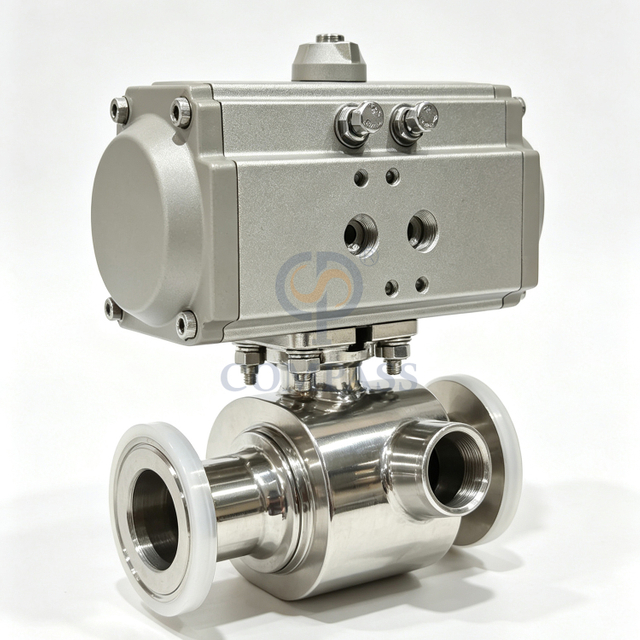
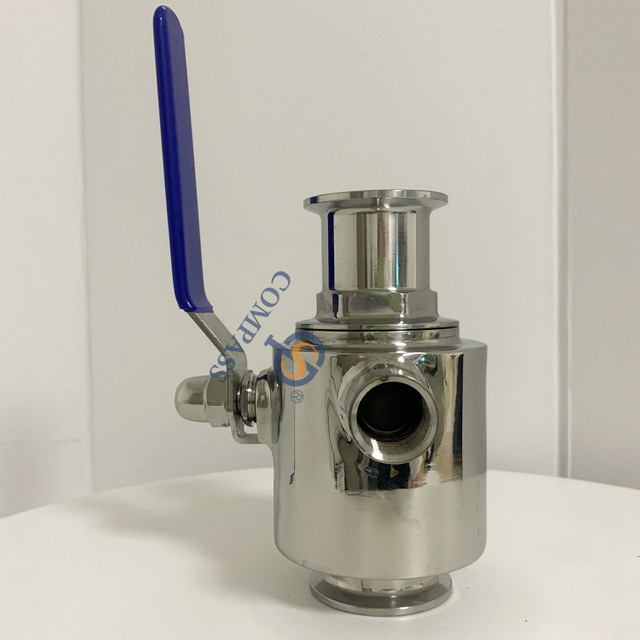
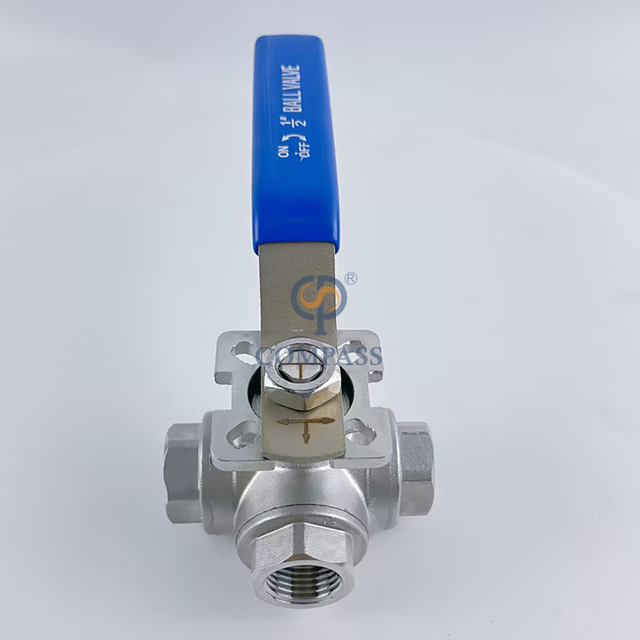
Xusheng(Sanicompass)'s Sanitary Ball valves are widely used in food, pharmaceutical, cosmetics, clean steam, alcohol, beverage, biochemical industrial process control occasions. It is a sanitary, automatic or manual operated Ball valve, suitable for various applications inside the stainless steel piping system.
Xusheng(Sanicompass)'s Ball valves has the following characteristics: compact and portable, small operating portable,hand lever can be installed on the side of the valve body, no matter of the flow direction. At the same time, our valves have welding, clamp, thread, union, flange and other connection methods, and meet DIN, SMS, RJT, ISO, IDF, 3A and other standards.
The parts of our ball valve can be replaced, Manual handle, pneumatic actuator and electric actuator can be exchangeable with each other. And the any kind of connection of valve body can be changeable.
And our ball valve are made form stainless steel 304 and 316L, the available size includes of 1/2”-4”, DN15-DN100, But customers have special size requirements, we can customize production. Xusheng(Sanicompass) can produce sanitary butterfly valves as per customers' design drawing and requirement.

Master sanitary check valve troubleshooting. Discover the root causes of leaks, evaluate repair vs. replacement, and prevent costly downtime.
Prevent tank damage and maximize yield. Discover how the SB pressure exhaust valve delivers precise, automated pressure control for hygienic tanks.
Master sanitary check valve installation to ensure hygienic compliance. Learn expert rules for flow alignment, orientation, and piping geometry.
Stop hidden corrosion and contamination. Compare SS304 vs SS316L to specify the right stainless steel sanitary check valve for your system.
Stop backflow and contamination in sanitary lines. Learn how to size, select, and specify hygienic check valves for strict CIP and SIP compliance.
Tri-Clamp or welded? Choose the right sanitary check valve connection to prevent contamination, ensure 3-A/FDA compliance, and optimize CIP/COP.
Selecting the optimal sanitary valve is essential for maintaining product purity, preventing batch contamination, and avoiding costly downtime in hygienic processing. By understanding process parameters, flow coefficients, and material compatibility—such as 316L stainless steel and proper elastomer seals—facilities can streamline automated CIP/SIP operations. Choosing between butterfly, ball, and diaphragm configurations based on specific viscosity and cleanliness standards ensures long-term operational efficiency, regulatory compliance, and seamless integration into modern fluid handling systems.
Specifying hardware for hygienic processing environments demands extreme precision to prevent batch contamination and regulatory failure. Common engineering mistakes include confusing tube dimensions with pipe sizes, selecting improper surface finishes, and misintegrating a sanitary valve. By prioritizing accurate sizing, strict material traceability, chemical-compatible elastomers, and industry standards like 3-A or ASME BPE, processing plants can safeguard product purity, minimize operational downtime, and ensure long-term system compliance.
Specifying the right hygienic fluid handling equipment is critical for avoiding product contamination, batch losses, and costly operational downtime. By systematically evaluating fluid viscosity, system head, and shear sensitivity, engineers can select optimal sanitary pumps and valves tailored to specific processing conditions. Adhering to stringent 3-A, EHEDG, and FDA compliance standards ensures seamless CIP/SIP cleanability, robust cross-contamination protection, and long-term process reliability across food, beverage, and biopharmaceutical production lines.
Selecting the right sanitary valve is essential for maintaining biological purity and preventing batch contamination in hygienic processing lines across food, pharmaceutical, and consumer chemical industries. Unlike standard industrial options, true sanitary valves utilize 316L stainless steel, polished low-Ra surface finishes, and crevice-free architectures compatible with automated CIP/SIP protocols. By evaluating key valve designs—including ball, butterfly, and diaphragm types—against specific process demands and verifying manufacturer quality control, process engineers can eliminate dead legs, safeguard product integrity, and ensure long-term operational reliability.