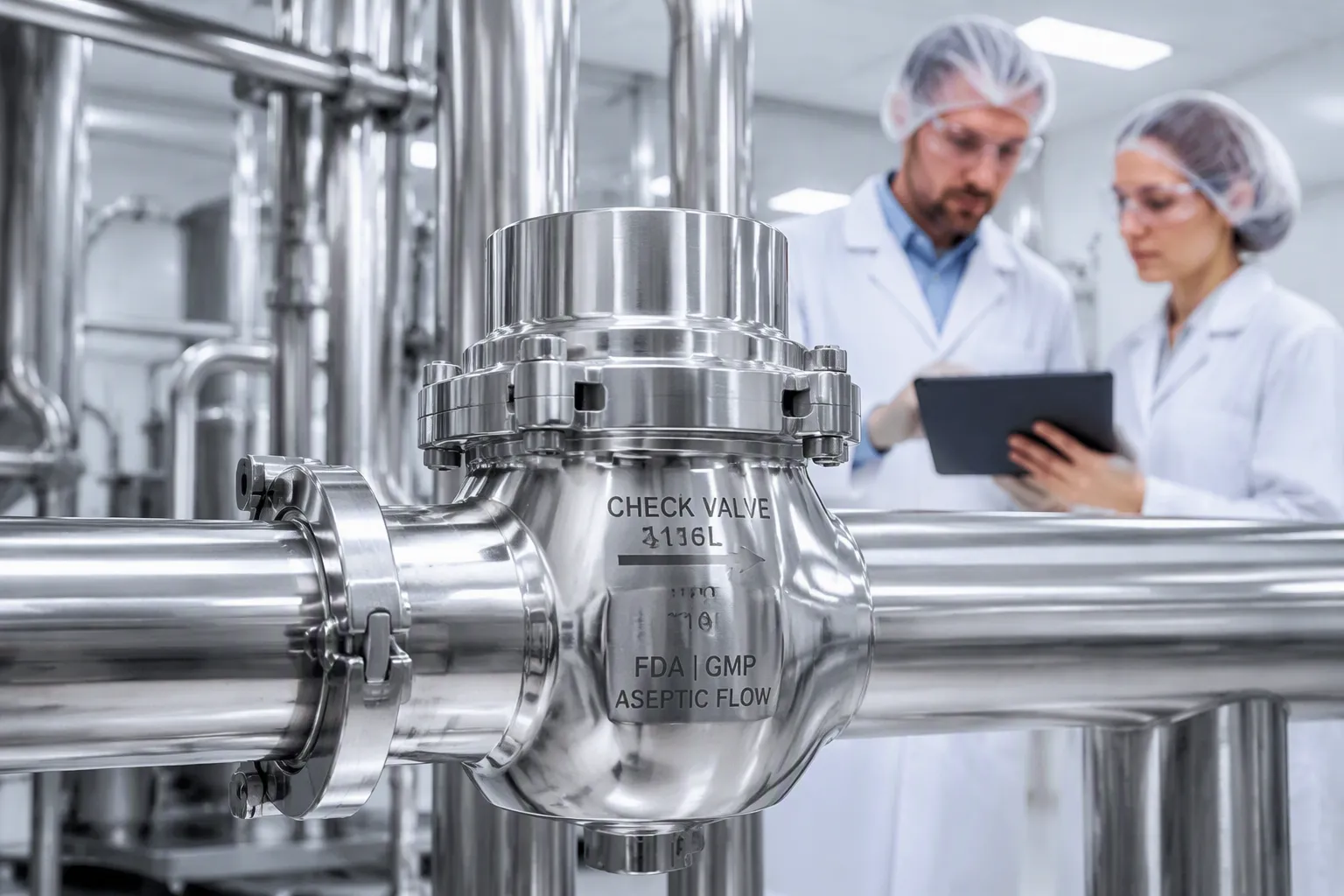
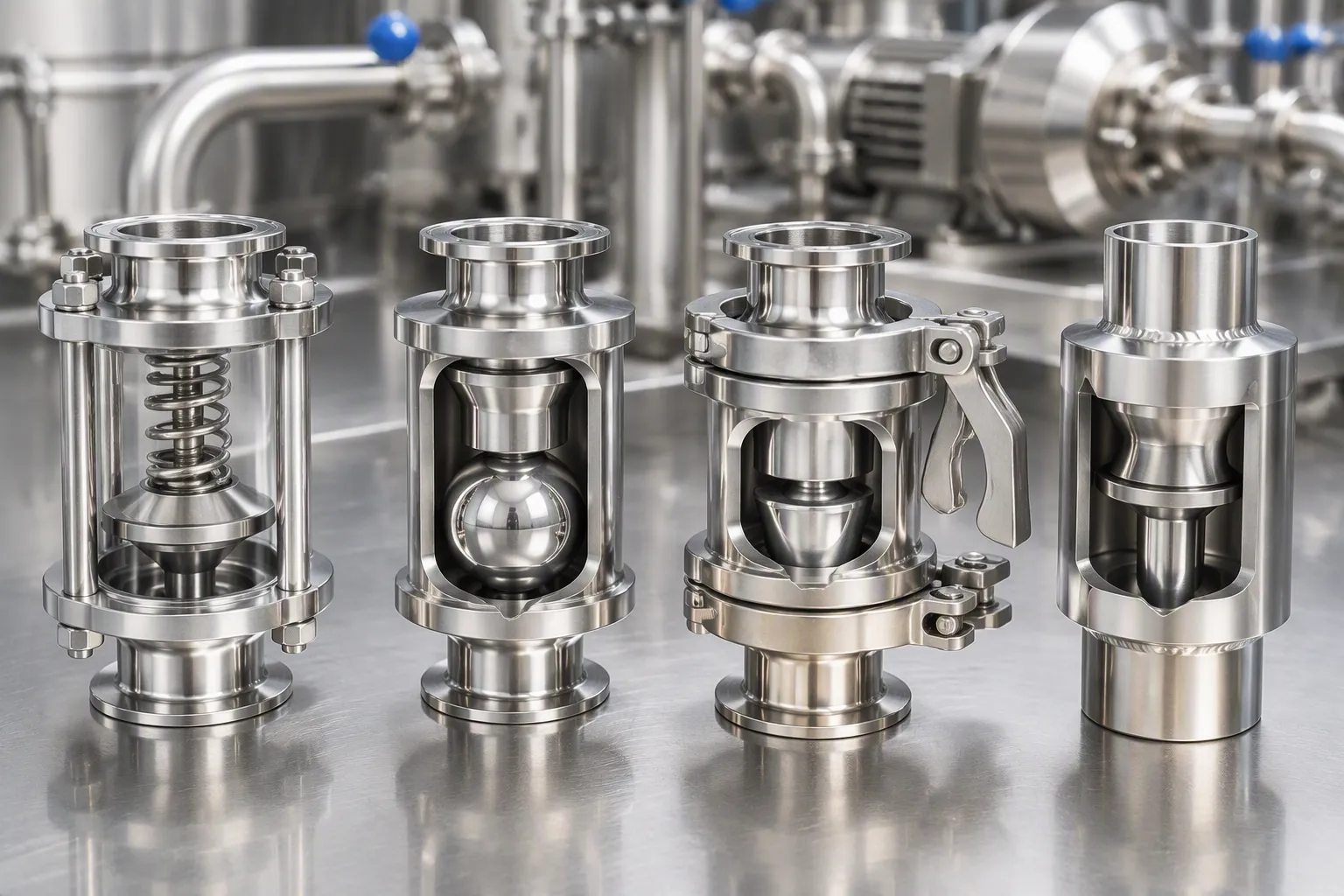
The four main sanitary check valve types are different in internal mechanism and connection method. Spring, ball, clamp, and welded types each solve specific flow control problems. Manufacturers make these valves from stainless steel. The smooth, crack-free inside stops dead space where bacteria could grow. Every unit meets 3A standards for food and pharmaceutical use. Choosing a sanitary check valve depends on factors such as fluid viscosity, cleanability needs, and pressure drop limits. Processors compare these factors before picking a valve for their production line.
Ball check valves work with thick products that have bits in them, like yogurt and fruit mixes.
Clamp connections let you clean quickly and do upkeep easily without special tools.
Welded valves make permanent, air-tight seals for sterile pipes in drug and biotech settings.
Pick a valve by looking at how thick the fluid is, how you clean it, and its pressure limits. This helps you get the right fit.
Spring-Loaded Sanitary Check Valve Design
How Spring Check Valves Work
A spring-loaded sanitary check valve uses a coiled spring to press the disc against the seat. Forward flow lifts the disc and squeezes the spring. When flow stops or turns backward, the spring pushes the disc back into the seat. This creates a tight shutoff on liquid products. The spring helps close the valve, so it does not depend on gravity or backflow pressure alone. This design works well in lines where the valve sits in any position.
Manufacturers make the spring from materials that fight corrosion and repeated cleaning. The table below shows common spring materials for 3A-compliant sanitary check valves.
Material
Role in 3A-compliant sanitary check valve
316 Stainless Steel
Standard spring material
HASTELLOY® C-276
Available spring material option
The 316 stainless steel spring resists damage from dairy acids and caustic wash solutions. HASTELLOY® C-276 gives another choice for harsh process fluids. Both options keep the inside surfaces smooth and free of dead space.
Pros, Cons and Typical Uses
The spring-loaded design gives fast, repeatable closure. It handles low-viscosity liquids with ease. The spring adds a small pressure drop, so processors must plan for this loss during pump sizing. The valve also needs enough forward pressure to beat spring tension. These traits make the design a great fit for clean liquid products.
Process fluid circuits within dairy processing facilities
Each application requires reliable shutoff and easy cleaning. The spring mechanism supports both goals. A processor who needs positive closure on a low-viscosity product will find this design a practical choice. The sanitary connection style still matters, and the next sections cover clamp and welded options.
Sanitary Ball Valves and Check Valve Use
Gravity and Backflow Operation
A sanitary ball check valve uses a simple ball inside the housing. This ball rests against a seat when the line is not running. Forward flow pushes the ball off the seat and lets product pass through. The ball rolls away from the seat during forward flow. When flow goes backward, the ball rolls back and seals against the seat. Gravity helps this happen in horizontal lines. The ball goes back to its seat without any spring or stem.
This design gives good sealing with very few moving parts. The ball moves freely inside a smooth chamber. There is no dead space where product can collect. Manufacturers polish the inside to 3A standards. A sanitary check valve of this style handles thick fluids and products with particles. The open chamber lets thick liquids flow around the ball. Particles pass through without blocking the mechanism. The ball lifts all the way off the seat, so pressure drop stays low.
Food and Dairy Applications
Dairy plants use sanitary ball valves for products that have solids or are very thick. Yogurt, cottage cheese, and fruit preparations move through these lines. The sanitary design handles small curds and fruit pieces. A spring-loaded valve would get clogged in these same lines. The ball check valve keeps product moving without blockages. The open flow path works well for lines that handle thick products.
These sanitary ball valves also show up in beverage and food processing. The 3A-compliant construction meets hygiene rules for direct product contact. Clean-in-place systems flush the open chamber without any trouble. The ball and seat resist caustic wash solutions. Processors pick sanitary ball valves when they need reliable shutoff and easy cleaning. Sanitary ball valves with clamp connections make installation simpler. The connection style still matters for maintenance. Clamp and welded options both work with ball check valves. A processor chooses the connection based on cleaning needs and line layout.
Clamp Valve Connection Types for Sanitary Systems
Modular Design for Easy Cleaning
A clamp connection uses a tri-clover design to attach valve bodies to process lines. Two matching ferrules meet face to face. A gasket sits between them. A clamp holds the parts together with a simple tightening action. This valve connection type allows quick installation and removal without special tools. An operator loosens one clamp and takes the valve off the line in seconds.
The modular design makes clamp valves easy to install in tight spaces. A flange connection needs bolts around a full circle. That job takes much longer. A clamp connection needs only one or two tightening points. Maintenance teams save time on every changeover. The clamp design also lets processors swap valve bodies without cutting pipe. This flexibility works well for lines that change products often.
CIP Suitability and Benefits
Clean-in-place systems depend on smooth, drainable surfaces. A clamp connection helps CIP because every wetted part comes apart quickly. The gasket seals tight during operation. An operator removes the clamp and checks the inside after cleaning. No hidden crevices trap product residue. This valve connection type meets sanitary standards for direct product contact.
Clamp connections also cut downtime during maintenance. A flange connection stays fixed and requires careful bolt torque. A clamp connection opens with a simple squeeze or turn. Teams replace gaskets and seals without moving nearby piping. The valve goes back to work fast. Processors who care about frequent cleaning pick clamp connections over flange options. The design balances hygiene, speed, and reliability for sanitary systems.
Welded Sanitary Check Valve Applications
Permanent Installation and Zero Dead-Leg
A welded sanitary check valve uses joints that stay in place instead of parts you can take off. The installer welds the valve body right into the process line. This connection makes a smooth, gap-free seal that no clamp or flange can equal. The one-piece forging and same-material weld get rid of spots where dirt can get trapped. Outer surfaces get electrolytic polishing, and inner surfaces get super-mirror polishing. No dust builds up, bacteria cannot grow, and leaks cannot form at the joint.
Dead legs are a big risk in high-purity systems. A dead leg is an area of low or no flow, greater than six diameters, where bacteria can grow and multiply given proper environment and nutrients. Fitting types are usually the limiting factor in lowering contamination risk.
Dead legs are areas of low to no flow, greater than six diameters, where bacteria can grow and multiply given proper environment and nutrients. Fitting types are generally the limiting factor in mitigating contamination risk. The most common fitting in high purity systems is the sanitary tri-clamp connection, with threaded and flanged connections seen as less proper. If tri-clamp connections are not possible, butt fusion should be used to create a smooth and seamless connection.
Welded ends with prefabricated welding positioning references help high-volume sanitary piping systems in clean areas. This connection style stops outside leaks and cross-contamination. It fully meets FDA, 3-A, and GMP aseptic production rules. The dead-leg-free sealing protection system keeps product zones sterile.
Best Practices for Aseptic Processes
Biotech and pharmaceutical lines count on welded sanitary check valves for sterile barriers. These facilities run validated SIP and CIP cycles. A permanent weld supports steady production without breaking the sterile boundary. Quick-clamp Y-type tees tend to build up deposits at seals, are likely to leak under high pressure, and cannot meet the demands of continuous high-volume transfer. A welded valve avoids these problems.
Installation needs careful planning because the joint is permanent. Maintenance teams cannot swap a welded valve during a production run. They must schedule replacement during planned shutdowns. Sealing reliability stays high across the full service life. Processors should check weld quality with inspection before the line returns to service. This practice protects product safety and supports regulatory audits.
Sanitary Check Valves Selection Guide
Key Differences by Design
Each design trades one strength for another. A spring unit closes fast and holds tight on thin liquids. The spring adds pressure drop, so pump sizing must account for that loss. A ball unit lets thick product and particles pass with little resistance. The ball rolls clear of the seat, so flow stays open and pressure drop stays low. Cleanability differs too. A clamp connection opens in seconds for inspection. A welded joint stays permanent and removes dead legs, but it demands a shutdown for replacement.
The table below compares the four designs on the factors that matter most.
Design
Flow Rate
Cleanability
Pressure Drop
Spring
Good for thin liquids
Easy with clamp ends
Higher from spring tension
Ball
Best for viscous fluids
Easy, open chamber
Low
Clamp
Depends on body style
Fastest to disassemble
Varies by body
Welded
Depends on body style
No dead legs, fixed joint
Varies by body
Processors also weigh these choices against sanitary diaphragm valves and sanitary butterfly valves. Those two families serve different duties. A diaphragm valve suits throttling and shutoff. A butterfly valve suits large-line isolation. A sanitary check valve handles one job only: it stops reverse flow without an operator.
Matching Valve to Use Case
High viscosity points to a ball design. Yogurt and fruit preparations move through the open chamber without clogging. Low dead-leg requirements point to a welded body. Biotech and pharmaceutical lines need that permanent, gap-free joint. Frequent cleaning points to a clamp connection. Teams pull the body, check the gasket, and return it to service fast. Low pressure drop points to a spring design only when the product is thin and the pump has margin.
No single design wins every case. A plant may run a ball unit on one line and a welded unit on another. The right pick follows the fluid, the cleaning schedule, and the pressure budget. Buyers who share those three details with a supplier get a valve that fits the line.
Fluid type, thickness, pressure drop, cleaning frequency, and dead-leg rules guide every choice. Thin liquids work best with a spring design. Thick products with particles need a ball design. Modular setups call for clamp connections. Aseptic lines demand welded bodies. Each sanitary check valve serves a clear purpose.
A quick reference helps buyers decide. Spring units suit low-viscosity liquids. Ball units handle viscous fluids. Clamp connections fit modular systems. Welded bodies protect sterile lines. Processors should share their fluid details, cleaning schedule, and pressure limits with a supplier. That step ensures the right sanitary valve arrives for the job.
FAQ
Which design works best for thick products with particles?
A ball design works well for thick fluids and small solids. The ball rolls off the seat when flow moves forward. Yogurt, cottage cheese, and fruit spreads pass through the open chamber without getting stuck. A spring design would jam these same lines. Processors choose the ball style for shutoff that works on tough products.
How does a clamp connection help with cleaning?
A clamp connection uses a tri-clover design. An operator loosens one clamp and takes the valve off in seconds. Every part that touches product comes apart for checking. No hidden gaps trap residue. Clean-in-place systems work better with this setup that comes apart easily. Teams swap gaskets without moving nearby piping.
When should a processor choose a welded body?
Aseptic and sterile lines need welded bodies. The permanent joint gets rid of dead legs where bacteria grow. Biotech and pharmaceutical plants count on this design for validated SIP and CIP cycles. The smooth, gap-free seal meets FDA, 3-A, and GMP rules. Replacement needs a planned shutdown.
What causes pressure drop in a spring-loaded valve?
The spring adds resistance to forward flow. Processors must plan for this loss during pump sizing. The valve also needs enough pressure to beat spring tension. Thin liquids work well with this design when the pump has margin. A ball valve gives lower pressure drop for thick products.
Can one sanitary check valve serve every application?
No single design wins every case. A plant may run a ball unit on one line and a welded unit on another. The right pick follows the fluid, the cleaning schedule, and the pressure budget. Buyers who share those details with a supplier get a valve that fits the line.