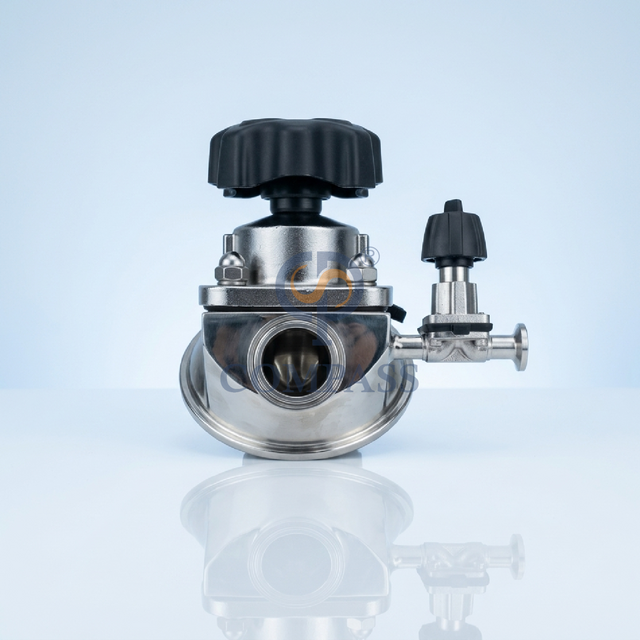
Choosing the right sanitary check valve starts with your process needs, not the valve itself. Engineers must look at four main areas: what the application requires, if materials work together, design and compliance, and installation and maintenance. A wrong choice can lead to contamination, expensive downtime, or failing regulations.
The plan is simple. First, check flow, pressure, temperature, and media properties. Next, pick 316L stainless steel and food-grade elastomers. Then decide between ball and disc types. Make sure it meets 3-A, FDA, and EHEDG rules. Finally, plan for upkeep. In food processing, this careful approach protects product quality and keeps lines running.
Key Takeaways
First, think about your process needs: flow, pressure, temperature, and media type.
Pick 316L stainless steel and food-grade elastomers such as EPDM for most hygienic uses.
Choose a valve design that is simple to clean and meets 3-A, FDA, and EHEDG rules.
Install the valve the right way and keep it working well to avoid dirt and shutdowns.
Use this guide as a checklist to pick the right valve and keep your system safe.
Define Sanitary Check Valve Requirements
Engineers should begin with the process, not the valve. A valve that works well in one line may fail in another. The operating conditions decide which sanitary check valve will work reliably. Four things matter most: flow rate, pressure, temperature, and the type of media.
Flow, Pressure, and Temperature
Flow features decide whether a ball or disc design fits the application. Ball-type valves work well in low-flow and low-pressure lines. Disc-type valves handle higher flow rates and tougher sanitary processing jobs. The wrong match causes chatter, early wear, or poor sealing.
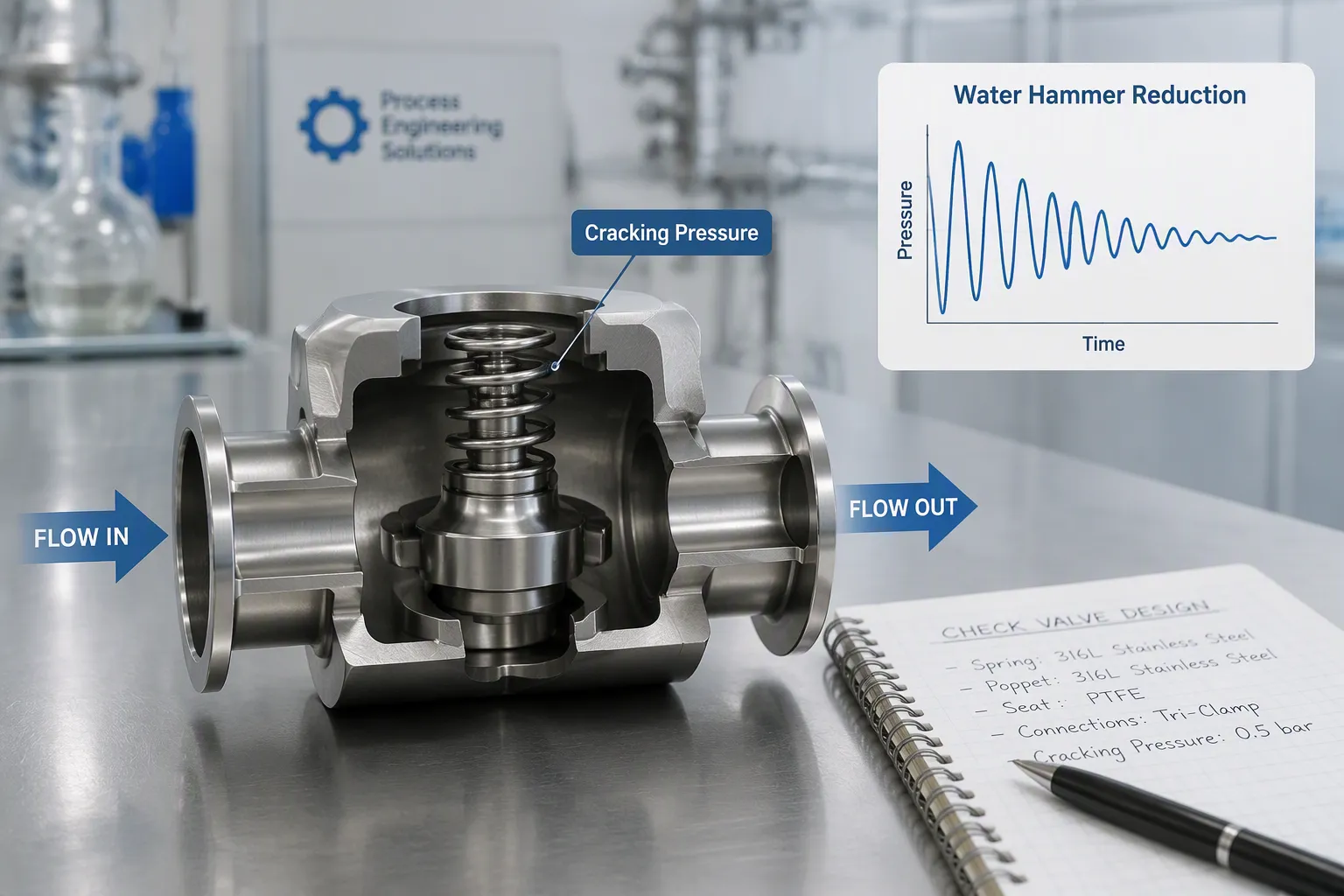
Differential pressure makes the valve work. In a spring-loaded design, forward pressure must beat the set spring force (cracking pressure) plus any static head. Once this point is reached, the spring compresses, the poppet lifts off its seat, and flow starts. When forward flow drops or reverses, the pressure across the valve falls. The compressed spring releases stored energy to push the poppet quickly and firmly back onto the seat before much reverse flow can happen.
Valve Type
Cracking Pressure Behavior
Reliability Implication
Swing check valve
Lower cracking pressure; relies mainly on disc weight to stay closed
Less suited to rapid-cycling or low-pressure systems
Spring check valve
Requires enough pressure to overcome spring tension
In pump-driven systems, cracking pressure contributes to more reliable closure behavior
Spring check valves close faster because of the spring's mechanical force. If the system cycles fast or has a pump shutdown, faster closing lowers shock risk.
The biggest plus of spring-assisted closing is limiting pressure shock (water hammer). Since the valve closes almost at once when flow drops, reverse flow lasts much less time. The fluid speed at closing is also limited, which cuts the pressure wave made when flow stops suddenly. Your choice must match the system's operating pressure range, mainly in gravity-fed or very low-pressure systems.
Temperature affects both the valve body and its seals. Hot processes in dairy lines and drug production need materials that resist heat damage. Engineers must check that the valve's rated temperature range covers the whole process, including clean-in-place and steam-in-place cycles.
Media Properties and Cleaning Cycles
The process fluid itself shapes material choice. Corrosive products, thick slurries, and gritty suspensions each need different elastomer and metal combos. Food processing and beverage plants must also think about cleaning agents and sterilization methods.
EPDM (peroxide-cured) fits daily CIP/SIP contact with caustic, acid, and steam. Under these conditions, it is usually replaced every 1–2 years. In autoclave cycles, EPDM lasts 1,000+ cycles. EPDM also handles 200+ cycles under daily SIP conditions at 121–134 °C, 2–3 bar, and 30+ minutes. FKM breaks down slowly in water and is not advised for steam service. No set replacement schedule exists for FKM in steam uses.
Corrosion resistance stays key for product-wetted parts. The chosen elastomer must resist swelling, hardening, and cracking across all cleaning chemicals and temperatures the system meets.
Select Compatible Materials
Stainless Steel Grades
Product-wetted parts in a sanitary check valve need 316L stainless steel. This low-carbon grade fights chloride pitting much better than 304. The Pitting Resistance Equivalent (PRE) shows why: 316L usually scores 23–30 across heats, while 304 falls between 18–22. That gap counts in chemical processing plants, where bleach and CIP chemicals harm weaker alloys.
Environment
304
316L
Recommended Grade
Chlorine-based cleaners (bleach, CIP)
Poor
Acceptable
316L
Salt spray / coastal outdoor
Marginal
Good
316L
Bodily fluids, saline solutions
Poor
Good
316L
304 can rust in chloride environments — salt water, sweat, bleach, and even tap water in coastal areas. Use 316L wherever chloride contact is possible.
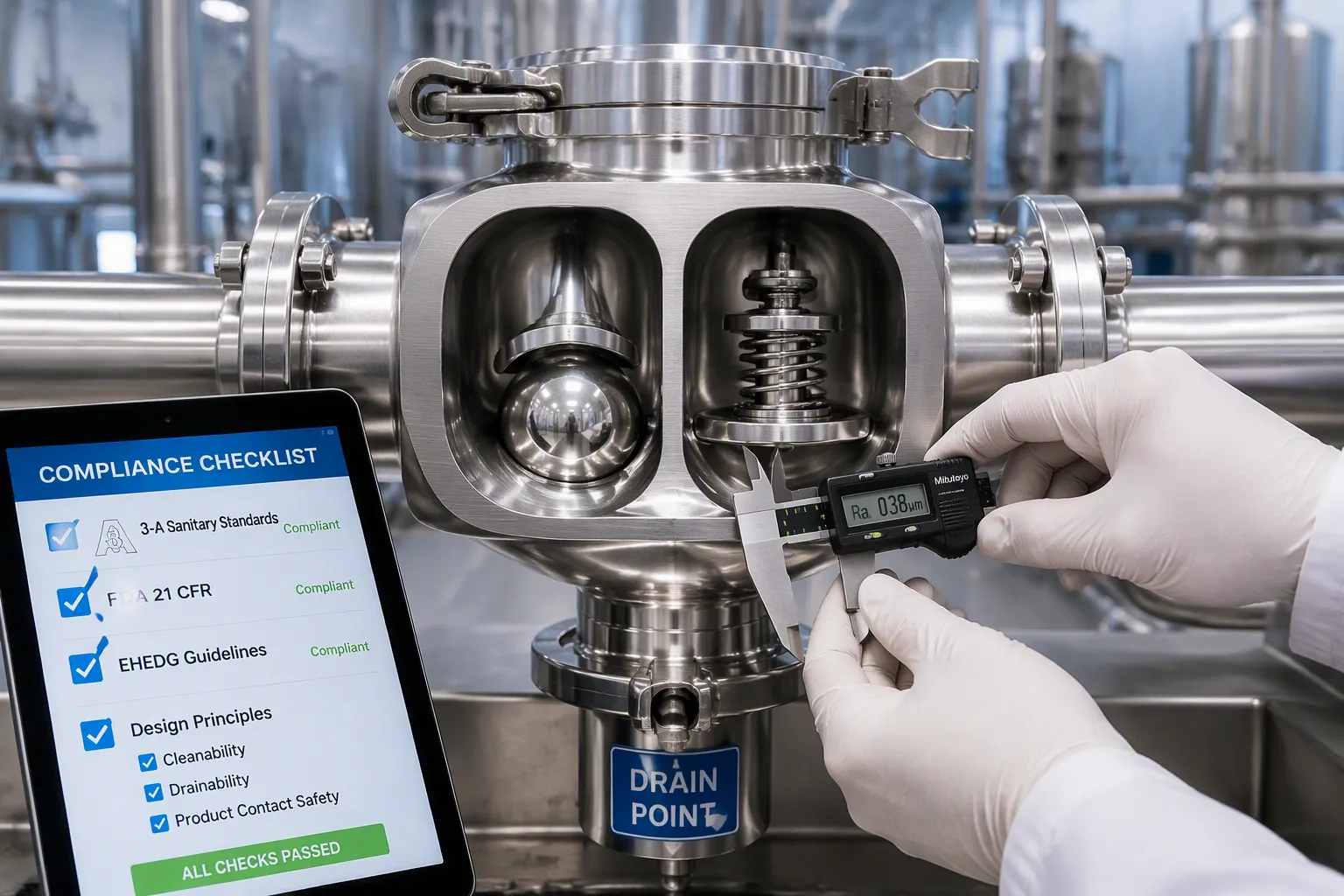
Passivation makes 316L even stronger. The process builds up chromium at the surface, pushing the Cr:Fe ratio above 3:1 in the outermost 10 nanometers. Free iron dissolves away, and molybdenum joins the passive film. This self-healing layer forms again after small damage, keeping corrosion resistance over years of service. Electropolished and passivated 316L reaches surface roughness (Ra) below 0.2 μm, which limits bacterial adhesion. For general food processing, a mechanical polish with Ra ≤ 0.8 μm is sanitary. Dairy and beverage lines often ask for Ra ≤ 0.5 μm, while pharmaceutical and bioprocessing need Ra ≤ 0.38 μm under ASME BPE SF1.
Elastomer Selection
Seal material must fit the cleaning routine. EPDM takes daily CIP/SIP contact with caustic, acid, and steam, usually lasting 1–2 years before replacement. Silicone gives 5–10 MPa tensile strength and 200–800% elongation at break under ASTM D412, with FDA 21 CFR §177.2600 compliance. EPDM reaches 7–21 MPa tensile strength and 300–600% elongation. Both work for food-grade service, though EPDM beats silicone in steam and caustic exposure.
PTFE-encapsulated seals widen chemical compatibility to strong mineral acids, organic solvents, and concentrated caustics. FEP encapsulation handles -60°C to +205°C; PFA reaches +260°C. These options fit aseptic and high-purity applications where standard elastomers break down.
Design for Sanitary Processing Applications
Valve Type and Cleanability
Ball and disc designs are different in how they deal with fluid flow and how easy they are to clean. A ball check valve uses a round ball that sits against a cone-shaped surface. The ball moves freely, so it works well in low-flow lines and thick products. A disc check valve uses a hinged or spring-loaded disc. This design handles higher flow rates and makes less turbulence. Cleanability is different too. The ball's simple shape leaves few small gaps, which helps it drain. The disc design may trap product near the hinge or spring, so engineers must check the inside shape carefully. Both check valve types show up in sanitary processing applications, but the wrong choice causes product to get stuck.
End connections and inside shape decide whether the valve supports clean-in-place (CIP) and steam-in-place (SIP). Tri-clamp and DIN connections make smooth joints with no gaps. Weld ends get rid of gaskets completely. Inside surfaces should have no dead legs and should slope toward the drain. A valve with a flat body may hold liquid after cleaning. A vertical position with a bottom drain point lets fluid escape fully. Engineers should check drainability during factory acceptance testing. A cleanable valve also needs a surface finish that stops bacteria from sticking. Product-contact surfaces should usually be set as Ra ≤ 0.8 µm.
Meeting 3-A, FDA, and EHEDG
Rules set a sanitary check valve apart from a standard industrial valve. Three standards matter most: 3-A, FDA, and EHEDG.
FDA 21 CFR 177.2600 covers rubber items meant for repeated use. It covers elastomer seal seats in every type of sanitary valve. The rule lists allowed base elastomers, accelerators, and additives. Approved materials include silicone, PTFE, Buna, and EPDM. Rubber products must be cleaned well before first use. Extraction limits apply: for fatty foods, extractables must stay under 20 mg per square inch after 7 hours of hexane reflux. For water-based foods, the limit is 175 mg per square inch after 7 hours of water reflux. Even though check valves are not named directly, they fall under every type of sanitary valve because they have elastomer seal seats.
3-A and EHEDG certification require specific paperwork. Buyers should check:
EHEDG certification is setup-specific and position-specific. The certificate applies only to the exact sizes, seal materials, and setups tested.
EHEDG certification is not a substitute for CIP validation. It proves cleanability under standard test conditions.
Installation conditions matter. Dead legs, wrong slopes, or hard-to-reach areas can defeat certified hygienic design.
Buyers should ask for the actual certificate, not just a logo. Confirm certificate number, issue date, and expiration date.
Documentation aspect
3-A Symbol Authorization
EHEDG Type EL certification
Primary document
Active 3-A Symbol Authorization number and public directory listing
EHEDG certificate PDF and public certified equipment listing
Verification method
Search the public 3-A certificate database by company, equipment type, or authorization number
Navigate the EHEDG certified equipment list, filter by company or product type, open certificate PDF
What to file with PO
Saved listing with renewal dates
Certificate PDF filed with PO documents
Material certificates for stainless steel and elastomers should be required. Weld procedures and inspection records should be written down. CIP or SIP validation should be planned early. The purchased setup must match the certified setup, including sizes, materials, and seal grades.
Plan Installation and Maintenance
Correct installation and regular upkeep decide if a sanitary check valve gives clean, reliable service. Bad placement or skipped checks hurt even the best hygienic design.
Installation Best Practices
The valve body must line up with the pipework to avoid stress points. Mount the valve vertically with the drain port at the lowest point. Gravity then clears leftover fluid after CIP cycles. End connections need correct gasket alignment. Tri-clamp joints need even clamp tightness to stop micro-gaps. Weld ends remove gaskets but require skilled welding. Dead legs trap product and bacteria. Every straight pipe run leading to the valve should slope toward the drain. Manufacturers list minimum straight pipe lengths before and after the valve.
Processes that need very clean conditions benefit from springless designs. Standard check valves with discs or balls rely on metal-to-metal contact against the seat. This constant mechanical contact causes slow wear over time. The metal bits that form threaten sterility in injectable drug making. Traditional valves with moving parts add contamination points. They need frequent cleaning or replacement to stay compliant. Wear-free alternatives remove moving parts and take away this risk. They make sterilization steps simpler.
Maintenance and Inspection
Regular checks catch wear before it hurts product quality. Technicians should look at disc check valves for scratches on the seat surface. Metal pieces from worn seats go straight into the product stream. In drug making, such particle contamination threatens sterility. Spring-loaded designs also need spring tension checks. A weak spring slows closing and lets flow go backward. How often to check depends on operating cycles. High-cycling lines need monthly checks. Low-cycling lines can wait for quarterly checks.
Springless designs remove possible sources of particle creation.
Elastomer seals break down over time. Peroxide-cured EPDM replaces every one to two years under daily CIP/SIP. Silicone needs checking for hardening or cracking after repeated steam cycles. Inspection records should include surface roughness readings. Ra values above 0.8 μm point to bacterial adhesion risk. Documenting every maintenance event helps with regulatory audits. 3-A and EHEDG certifications require traceable cleaning and inspection logs. A planned replacement schedule stops unplanned downtime. Workers must check that replacement parts match original specs.
A good selection process has four steps. First, figure out the flow, pressure, temperature, and media needs. Second, pick 316L stainless steel and food-grade elastomers. Third, design for easy cleaning and check 3-A, FDA, and EHEDG compliance. Fourth, plan the installation and upkeep.
The right sanitary check valve keeps products safe, cuts downtime, and meets regulations. A wrong pick leads to contamination and failed audits.
Readers should use this outline as a handy checklist. Use it when choosing valves or talking with suppliers. Careful review at each step keeps hygienic processing systems safe and efficient.
FAQ
Which stainless steel grade suits sanitary check valve wetted parts?
316L stainless steel is the normal choice. Its Pitting Resistance Equivalent usually scores 23–30, while 304 falls between 18–22. That gap counts in plants that use bleach or chloride-based CIP chemicals. Passivated 316L also heals small surface damage on its own, which makes it last longer.
How often should operators replace EPDM seals?
Peroxide-cured EPDM usually lasts one to two years with daily CIP/SIP contact with caustic, acid, and steam. In autoclave cycles, it holds up for over 1,000 cycles. FKM breaks down slowly in water and is not advised for steam service, so no set replacement schedule applies there.
What surface finish do hygienic applications require?
General food processing needs a mechanical polish with Ra ≤ 0.8 μm. Dairy and beverage lines often ask for Ra ≤ 0.5 μm. Pharmaceutical and bioprocessing need Ra ≤ 0.38 μm under ASME BPE SF1. Electropolished and passivated 316L can reach Ra below 0.2 μm.
Does EHEDG certification cover every installation?
No. EHEDG certification is setup-specific and position-specific. It applies only to the exact sizes, seal materials, and setups tested. Dead legs, wrong slopes, or hard-to-reach areas can defeat certified hygienic design. Buyers should ask for the actual certificate and confirm its number and expiration date.
Why do aseptic lines favor springless check valve designs?
Springless designs remove moving parts and get rid of metal-to-metal contact that makes wear particles. Standard disc and ball valves rely on seat contact, which slowly wears and threatens sterility in injectable drug production. Wear-free alternatives make sterilization simpler and lower contamination risk.