A sanitary check valve prevent backflow by allowing fluid to move in only one direction. The valve closes automatically as soon as flow stops or reverses, using a spring-loaded disc or ball that responds to pressure changes. These valves are critical in food and beverage processing, where they keep contaminated liquid from entering clean product lines and protect pumps and other equipment from damage. Their sanitary design helps meet strict hygiene standards, which is essential for product safety and quality. By preventing backflow, sanitary check valves play a vital role in keeping processing systems safe and reliable.
Key Takeaways
Sanitary check valves stop backflow on their own with a spring-loaded disc or ball.
They keep food and drinks safe from germs and stop equipment from getting damaged.
These valves have smooth designs without crevices and use materials like 316L stainless steel.
They follow strict FDA and USDA rules for hygiene and clean-in-place cleaning.
Picking the right valve helps it work reliably and keeps product quality good.
How Sanitary Check Valves Prevent Backflow
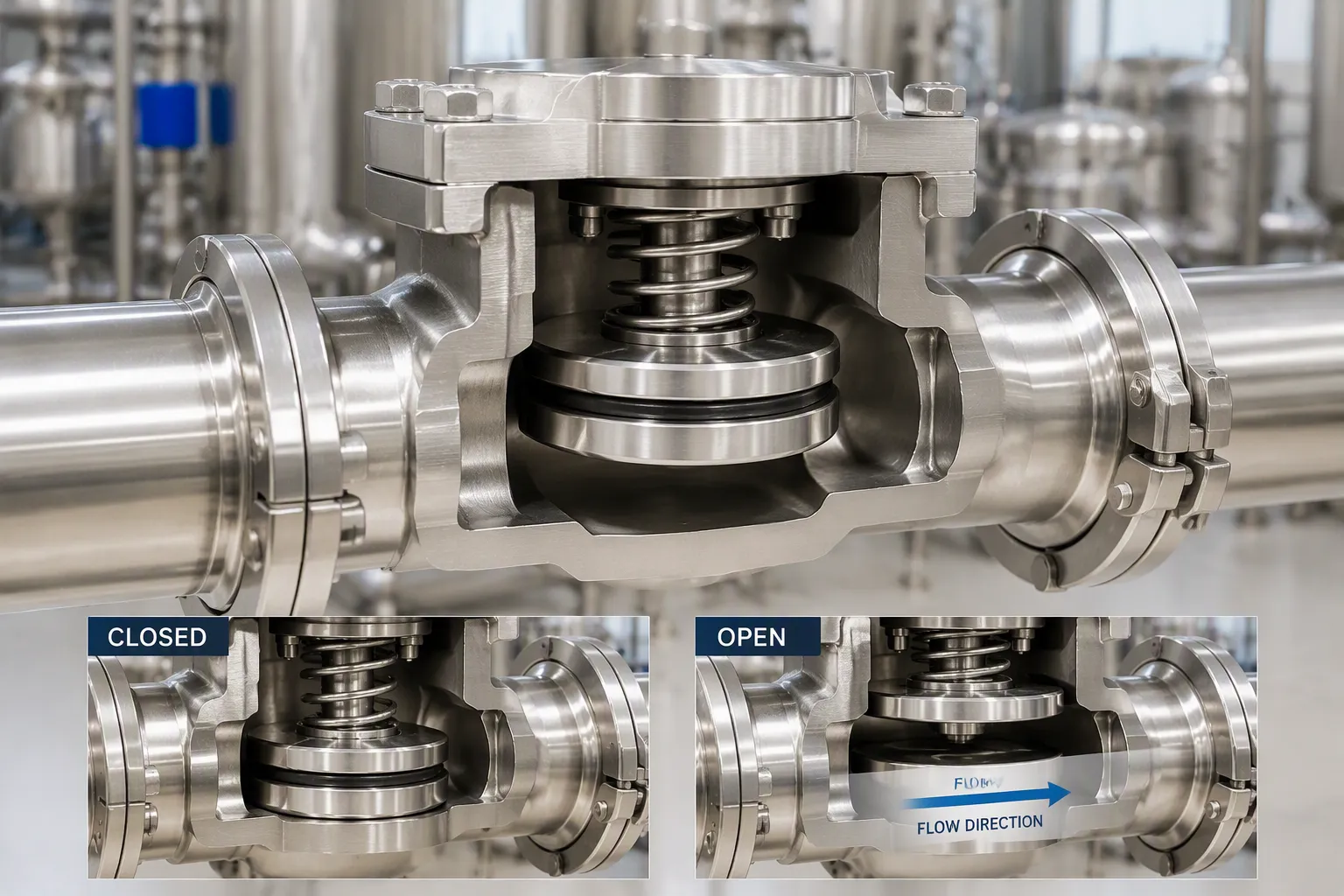
The valve works based on pressure. Forward fluid pressure needs to be stronger than the spring force to open the valve. When pressure falls or flow goes backwards, the valve shuts on its own. No external power or person is needed. The valve senses what's happening in the line and reacts right away.
Spring-Loaded Disc Operation
A spring keeps the disc pressed against a machined seat. When fluid flows forward, pressure from the upstream side pushes the disc away from the seat. The valve opens when pressure is higher than the cracking pressure. Then fluid flows through the valve body. The disc stays lifted while forward flow continues. When flow stops, the spring pushes the disc back to the closed position.
Cracking pressure is the smallest upstream pressure required to open the valve. Below this pressure, the valve stays closed. Different disc materials create different cracking pressures. A polymer disc made of Teflon or PEEK opens at about 0.04 psid. A 316 stainless steel disc with an EPDM soft seal opens at about 0.13 psid. A polypropylene disc uses only gravity. These low cracking pressures let the valve work with very little pressure drop in the system.
The spring force must balance two needs that work against each other. Too little force makes the disc flutter at low flow rates. Too much force wastes pump energy. The cracking pressure formula is simple: cracking pressure equals spring preload force plus disc weight part divided by disc area. A typical inline valve uses a cracking pressure of about 3 psi. This gives reliable closing without too much pressure loss. Engineers pick the spring rate carefully to keep performance steady over the valve's life.
The materials meet FDA and USP Class VI standards. The spring is made of AISI 301 stainless steel. The disc and body use 316L stainless steel to resist rust. Seals use FDA-compliant EPDM, silicone, Viton, or PTFE. These materials can handle many SIP cycles without getting hard or breaking down. The smooth surface finish stops bacteria from gathering in small spaces.
Automatic Sealing on Reverse Flow
When forward pressure drops, the spring pushes the disc back onto the seat. The valve seals right away. A sanitary check valve prevents backflow by reacting to pressure changes. Another sanitary check valve prevents backflow by closing before any reverse column forms. Closure time ranges from 20 to 80 milliseconds in spring-loaded designs. This fast action stops water hammer and protects downstream equipment from pressure bursts. Slow-closing valves let reverse flow build speed, causing sudden pressure spikes when the disc finally seats.
The spring alone provides the sealing force. No actuator or controller is needed. Sanitary check valves work reliably cycle after cycle. The disc lifts only when forward pressure is present. The spring forces it shut whenever flow reverses. This simple mechanism keeps flow going in one direction at all times. The design stops backflow automatically without any manual help.
Sanitary valves in the food and beverage processing industry prevent cross-contamination. These valves keep cleaning solutions and raw product away from finished product lines. Sanitary valves protect product purity and follow strict hygiene rules for safe operation.
The pressure-based mechanism works all the time without needing attention. Choosing the right spring ensures reliable operation. These valves give important protection for both product quality and equipment safety.
Evidence sources referenced: Cracking pressure values for polymer disc (0.04 psid) and 316 SS disc with EPDM seal (0.13 psid); spring materials (AISI 301 stainless steel, 316L stainless steel); seal materials (EPDM, silicone, Viton, PTFE); closure time range (20–80 ms); cracking pressure formula and 3 psi typical value; FDA and USP Class VI compliance.
Importance in Food and Beverage Processing
Preventing Contamination and Spoilage
Reverse flow creates big dangers in food and beverage processing. When flow goes backward, non-potable water, cleaning solutions, or raw product can get into finished product lines. Just one event can ruin a whole batch. The results include spoiled products, pathogen growth, and breaking of regulations. The FDA requires proper prevention under 21 CFR 117.37, which covers sanitary facilities, water supply, and plumbing controls. This rule requires that utility lines for process water, steam, compressed air, and sanitation include prevention to stop cross-contamination. Without protection, non-potable water can enter product lines with no visible sign.
The table below shows proven risks from reverse flow in processing plants:
Risk
Documented Concern
Plumbing back-siphoning
Water used to make vacuum can siphon back into the drinking water supply
Air reverse flow from exhaust systems
Building and equipment air exhausts must stop reverse air or material flow when not running
Moisture exhaust reverse flow
Moisture exhaust must control reverse flow of air, material, or condensation with drainage away from product
Pasteurizer–evaporator line reverse flow
Vacuum breakers and positive shut-off valves in these lines need regular checks
Raw/pasteurized cross-connections
No cross-connections allowed between raw piping or storage vessels and packaging equipment
Each of these risks can cause product loss, equipment damage, or health hazards. Floor drainage must also be sized and sloped the right way with separate outfalls for raw and pasteurized zones. This design choice must be made before floor slabs are poured, showing why planning matters for overall safety.
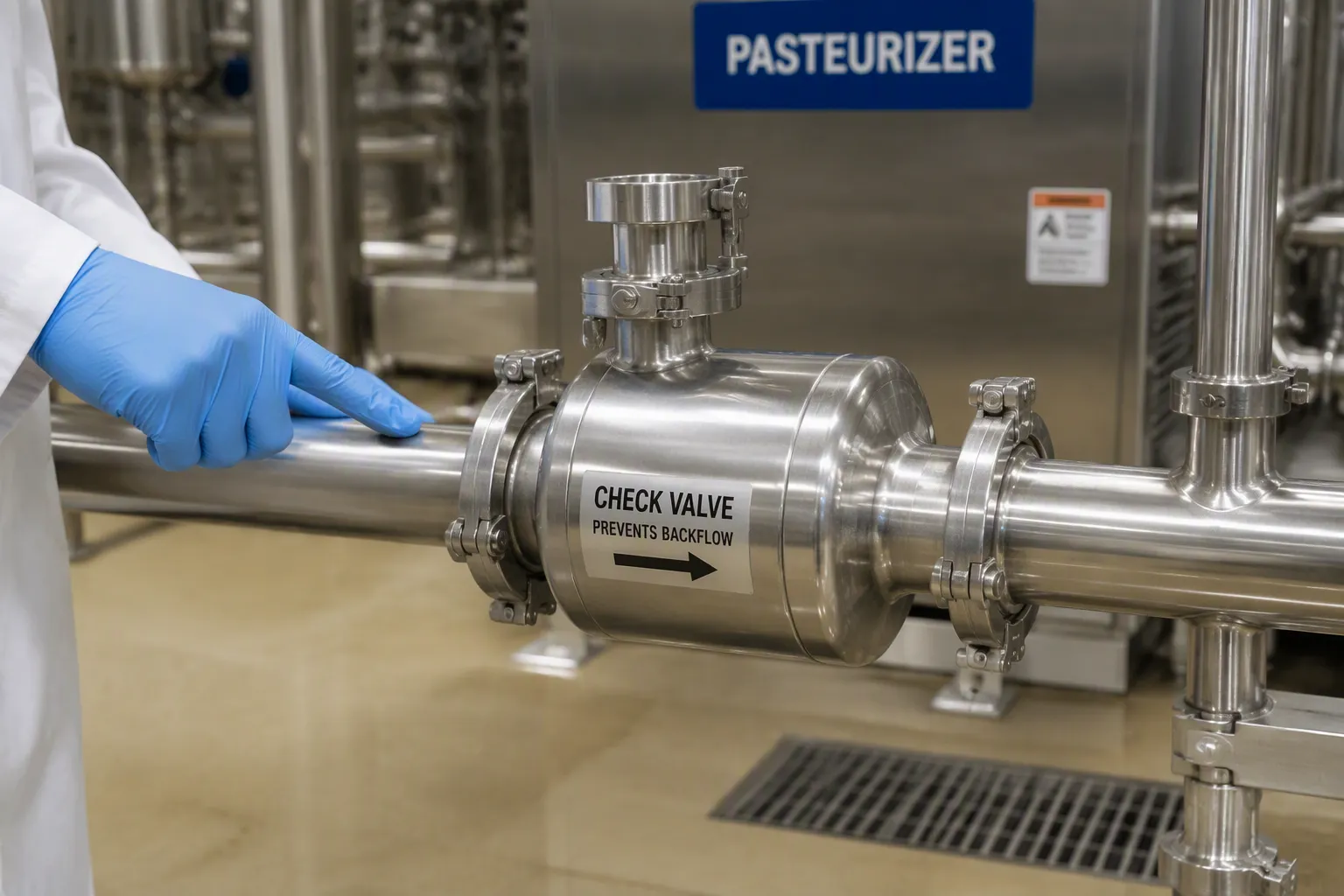
Every facility needs reliable prevention at possible cross-connection points. The way a sanitary check valve prevent backflow is simple: it closes on its own whenever forward pressure drops. This simple action stops these risks before they turn into real contamination events.
Protecting Pumps and Process Equipment
Reverse flow also harms costly process equipment in the food and beverage industry. When a pump stops, gravity can push reverse flow through the system. This sudden reversal causes water hammer. Water hammer makes pressure spikes that damage pump impellers, seals, and piping. A properly installed valve closes right away when flow reverses, stopping water hammer damage.
Sanitary check valves protect equipment in many uses across the industry. In boiler feed and discharge lines, they stop reverse flow and water hammer, keeping feed pumps safe. In cookers, refrigeration systems, and steam lines, these sanitary valves do the same critical job. Vacuum breaker threaded check valves stop condensate backup, protecting valves from collapsing pressure and the pump damage that follows.
Production facilities also depend on these valves in several areas. Carbonated soft drink filler inlets use spring-assisted lift checks to stop reverse flow and seat erosion from CO₂ pulsation, protecting filler pumps. Fruit puree transfer lines need full-port swing checks with strainers to prevent particulate jamming and reverse flow. Wort boil kettle outflow requires high-temp lift checks to prevent spring relaxation and delayed closure, avoiding boil-over and protecting downstream pumps. CIP return lines benefit from dual-plate valves installed vertically, which reduce biofilm incidents and prevent bacteria contamination along with bacterial buildup. Each use demands a specific valve design matched to the fluid type, temperature, and flow pattern.
Each use in the industry brings different challenges. The right valve design solves those challenges while keeping sanitary conditions. Proper selection and placement of these valves keeps production running and prevents costly downtime.
Sanitary Check Valves vs. Standard Check Valves
Standard and sanitary check valves both let fluid flow one way. But their designs are different in ways that affect product safety. A standard valve works fine in industrial pipes. However, that same valve cannot be used with food or drinks.
Hygienic Materials and Smooth Finishes
Sanitary valves use 316L stainless steel for the body, disc, and spring. This metal does not rust when cleaned with harsh chemicals or when touching acidic foods. Standard valves often use carbon steel or brass. Those metals can leak tiny particles into the product. Seals in sanitary valves follow FDA and 3-A rules. Common seal materials are EPDM, silicone, Viton, and PTFE. These seals can handle many steam cleaning cycles without breaking or swelling.
Surface finish is another big difference. A standard valve body has a rough inside surface. Food bits stick to that surface, and bacteria can grow there. A sanitary valve body has a smooth inside surface with very low roughness. This finish lets the valve drain fully and leaves few spots where liquid can collect.
Crevice-free design is the most important difference. A sanitary check valve has no dead legs or hidden spots where germs can gather. Controlled curves, full-bore paths, and exact ferrule alignment stop tiny gaps at joints. Flush, self-aligning faces prevent ledges and misalignment. Orbital butt welds and shaped ferrules avoid any intrusions or recesses. These features lower biofilm risk and help with approved cleaning methods. A standard valve has threaded connections and recessed seats. Those features trap dirt and are hard to clean.
Clean-in-Place Compatibility
Clean-in-Place systems push cleaning liquid through the process line without taking it apart. Sanitary valves are made for this job. Their smooth inner surfaces let cleaning fluid touch every spot that contacts product. Their crevice-free shape stops dirt from hiding in gaps. Their seals can handle many rounds of hot caustic and acid solutions.
Standard valves do not work well with Clean-in-Place. Threaded bodies and rough castings trap dirt that cleaning liquid cannot get to. A standard valve must be taken out and cleaned by hand. That adds work and can cause mistakes when putting it back. Sanitary valves stay in place and get cleaned in the line. This keeps sanitary equipment ready for the next batch. It also keeps the whole processing line clean.
A sanitary check valve prevents backflow using a pressure-sensitive one-way system. A spring-loaded disc or ball opens when forward pressure pushes it and seals as soon as flow reverses. In food and beverage processing, this action protects product purity and avoids water hammer. It also shields costly equipment and meets strict FDA and USDA rules. Sanitary valves use 316L stainless steel, smooth finishes, and crevice-free paths. These features set them apart from standard valves and stop bacteria and bacterial buildup. For any food or beverage processing line, this simple component guards both quality and safety. Its reliable closure keeps contamination out and production running.
FAQ
How does a sanitary check valve operate?
The valve opens when forward pressure is stronger than the spring force. It shuts on its own when flow stops or turns around. This easy design stops backflow without any outside controls.
Why are sanitary valves critical in food and beverage processing?
Sanitary valves keep raw product and cleaning solutions out of finished food lines. They also shield pumps from water hammer. The processing industry relies on them for hygiene.
What materials are used in sanitary check valves?
They use 316L stainless steel for the body and spring. Seals are FDA-compliant EPDM, silicone, Viton, or PTFE. These materials work well for beverage processing.
How do sanitary valves meet safety standards?
They have smooth finishes and a crevice-free design. They allow Clean-in-Place cleaning. This meets the safety rules for beverage production.