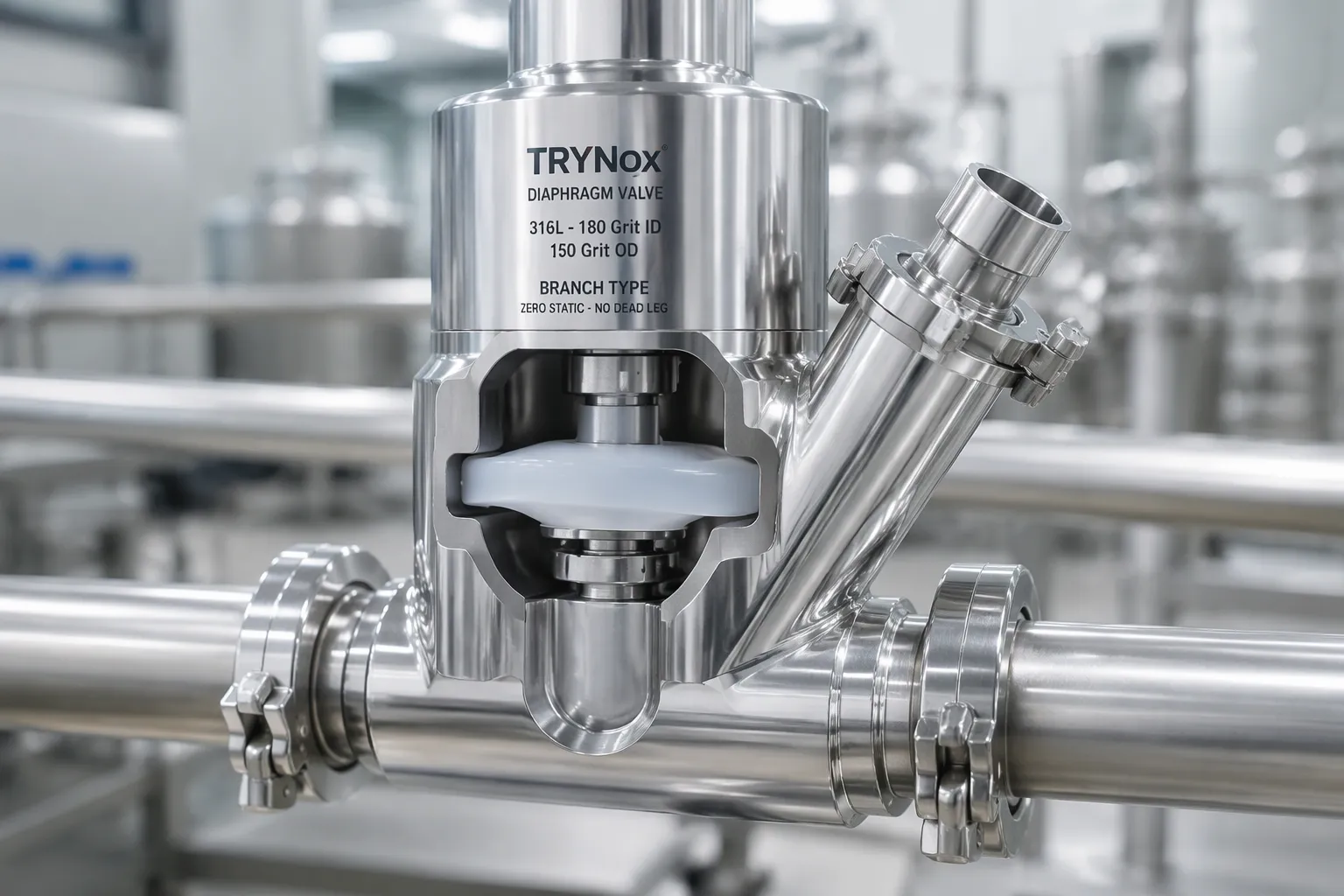
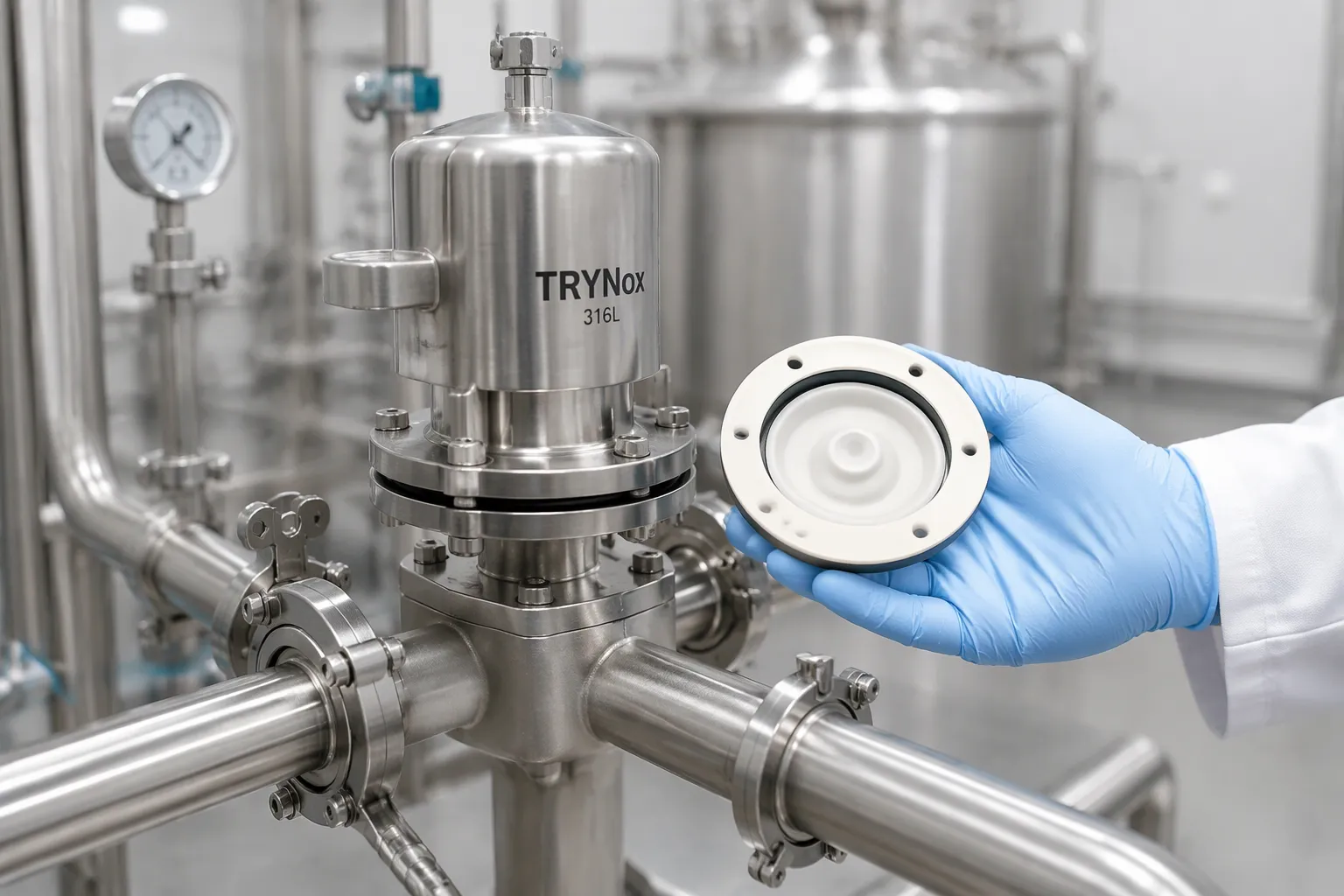
The Trynox sanitary diaphragm valve branch type is a clean shut-off valve with an extra port for sampling, draining, or parallel flow. A flexible diaphragm seals against a weir or saddle seat to keep the inner parts away from the process fluid. This design works well in food, beverage, biotech, and pharmaceutical industries that need clean or sterile processes. The branch port gives operators a special spot to take samples, drain lines, or send fluid in parallel without stopping the main flow. Its 316L stainless steel body supports clean processing and fights rust. The valve works with a simple multi-turn action: the actuator pushes the diaphragm down to close and lifts it to open. This setup keeps the actuator apart from the product, which protects both the fluid and the inside parts.
Key Takeaways
The branch port gives a special place for sampling, draining, or parallel flow without stopping the main process.
The diaphragm keeps the process fluid away from the actuator and internal parts. This ensures clean and sterile operation.
The 316L stainless steel body resists rust and meets strict clean standards for food, beverage, and pharmaceutical use.
Pick the right diaphragm material: use EPDM for caustic and mild acid, and use PTFE for hot caustic service above 70°C.
What Is a Trynox Sanitary Diaphragm Valve Branch Type
Definition and Core Components
A Trynox sanitary diaphragm valve is a shut-off valve. A soft diaphragm is the part that opens and closes it. This flexible membrane sits between the process fluid and the upper operating assembly. When the valve closes, the diaphragm moves toward the valve seat and blocks the flow passage. When the valve opens, the diaphragm lifts away from the sealing surface and fluid passes through. The main design benefit is that the process medium stays apart from the stem or actuator mechanism. Only the body and the diaphragm touch the product.
The branch type adds one or more ports to the standard body. These extra ports are used for sampling, draining, or parallel routing. A branch connection taken directly off the main line avoids a stub of pipe between the main and the valve seat. That stub would be a dead leg. A dead leg will not drain, and clean-in-place (CIP) will not reliably reach it. A branch body with a zero static design fixes this problem for sample points and any branch that is not in constant flow.
The diaphragm closes against a weir or saddle seat. This machined surface forms a positive closure when the diaphragm presses against it. The diaphragm is usually made of an elastomeric material or PTFE filled with an elastomer such as EPDM or VITON.
The table below sums up the main components and design features.
Component / Feature
Detail
Construction
Valve body with two or more ports, a diaphragm, and a weir or saddle seat; made from plastic or metal
Diaphragm seal
Flexible membrane forming a positive closure against the weir
Model / SKU
Trynox TAVA3WC sanitary diaphragm valve branch type
Sizes
1" x 3/4", 1 1/2" x 1", and 2" x 1"
Grade
316L stainless steel
Surface finish
180 Grit ID / 150 Grit OD
Fitting
Fits to sanitary stainless steel tubing
Applications
Food, beverage, biotech, pharmaceutical, and other hygienic industries
Body, Diaphragm, Actuator, and Branch Port Functions
Each part has a clear job. The valve body holds the fluid and carries the ports. The diaphragm presses onto the machined weir to stop flow. The stem and compressor push the diaphragm down and pull it up. The bonnet covers the upper assembly. The actuator supplies the force for movement. The diaphragm keeps the process fluid apart from the stem, compressor, and bonnet, so only the body and the diaphragm are wetted.
The branch port gives operators a dedicated point to take a sample, drain the line, or route fluid in parallel. This port works while the main path stays closed or partly open.
The 316L stainless steel body supports hygienic processing and resists corrosion. The valve carries a maximum operating pressure rating that depends on valve size.
Maximum operating pressure rating of 140 psi (depending on valve size) at 70 degrees Fahrenheit ambient temperature
How the Trynox Sanitary Diaphragm Valve Works
Diaphragm Movement and Sealing Mechanism
The valve controls flow by moving in a straight line. A soft diaphragm moves up and down in a straight path instead of spinning like a ball or butterfly disc. A turn handle links to a plunger, and the plunger pushes on the diaphragm. The diaphragm then bends to control the flow path.
The closing steps follow a simple order:
The operator turns the handle to the right.
The plunger moves the diaphragm down toward the seat.
The diaphragm presses against the weir or saddle seat.
The seal blocks the path, and flow drops until it stops fully.
Opening does the opposite. Turning the handle to the left lifts the diaphragm off the seat. This motion opens a path for the fluid. Hand operation often takes many turns to open or close all the way, so it is slower than quick valves like ball or butterfly types. That slower travel fits clean processes, where soft, steady motion protects the product and the seat surface.
The weir type, also called the saddle type, uses a raised barrier inside the body. The diaphragm closes and presses down on this weir to stop or slow flow. The seat shape gives the diaphragm a set contact line, so the closure stays the same over many cycles.
Branch Flow Path and Operational Modes
The branch port changes how operators use the valve. When the main path is closed, the branch port still gives a route for fluid. An operator can open the branch to take a sample, drain the line, or send product to a parallel line. When the main path is partly open, the branch port takes some flow for sampling or routing while the rest keeps going downstream.
This setup supports several working modes. In sampling mode, the main path stays closed and the branch feeds a sample point. In drain mode, the branch sits at the low point and empties the line. In parallel mode, the branch feeds a second process line while the main path serves the main line. Each mode keeps the branch close to the seat, which stops a dead leg that would trap fluid and block cleaning.
The diaphragm keeps the actuator and inner parts away from the process fluid. Only the body and the diaphragm touch the product. This gap supports rust-proof operation, because harsh media never reach the stem, compressor, or bonnet. It also supports clean operation, because the wetted surfaces stay smooth and easy to clean. A trynox sanitary diaphragm valve uses this same separation rule across its size range, and the branch body adds it to sampling and draining points without adding a separate valve.
Key Features, Benefits, and Applications
Sanitary Design, Cleanability, and Compliance
The branch body helps keep things clean in ways a normal valve cannot. The branch port sits near the seat, so no hidden pocket traps product between the main line and the sample or drain point. Operators can clean the valve in place without taking it apart. The smooth 316L stainless steel wetted surfaces stand up to normal cleaning chemicals, like caustic and acid washes.
Clean service sets clear rules for any valve in food, beverage, biotech, or pharmaceutical lines:
The valve must drain fully and clean in place without being taken apart.
Steam sterilization in place usually runs at 121–135°C.
Product-contact surfaces need a smooth finish, with Ra ≤ 0.8 μm (32 micro-inch) for stainless steel under 3-A standards.
ASME BPE designations go tighter: SF4 requires Ra ≤ 0.38 μm, and SF6 requires Ra ≤ 0.25 μm for clean steam and Water-for-Injection systems.
Elastomers must meet USP Class VI and appear in FDA 21 CFR 177.2600.
A trynox sanitary diaphragm valve meets these rules through its smooth body and flexible diaphragm. The diaphragm material matters for chemical resistance. EPDM handles caustic and mild acid well, while PTFE suits hot caustic service above 70°C. Buna-N is not recommended for cleaning service because caustic attacks it above 50°C.
Best-Fit Uses: Sampling, Draining, and Parallel Processing
The branch type works best where a line needs a second access point without a second valve. Inline sampling is a natural match. An operator closes the main path and draws a sample from the branch, which sits close to the seat and holds no stagnant product. Drain points suit the design just as well. Mount the branch at the low point of a line, and gravity empties the run through that port.
Parallel processing lines also benefit. The branch feeds a second circuit while the main path serves the primary line. Each mode keeps the branch short and close to the seat, which supports clean-in-place performance and full drainability. These uses fit food, beverage, biotech, and pharmaceutical processes that demand reliable cleaning between batches.
Comparison with Other Diaphragm Valve Types
Performance, Application Fit, and Compliance
Diaphragm valves come in six structural forms: house type, DC type, cut-off type, straight-through type, gate type, and right-angle type. Each form shapes the flow path in its own way. The branch type stands apart because it adds a dedicated port near the seat.
The straight-through type sends fluid along a direct line with minimal change in direction. That layout suits main-line shut-off duty and keeps pressure drop low. The branch type trades some of that simplicity for a second access point. An operator gains a sampling or drain connection without adding a separate valve.
The cut-off type focuses on tight closure at the seat. It fits lines that need reliable isolation. The branch type also seals against a weir or saddle seat, so it isolates well. Its advantage shows up where a line needs both isolation and a side connection.
Cleanability differs by form. The branch port sits close to the seat, so no dead leg traps product between the main line and the sample point. Straight-through and cut-off bodies lack that port, so a sampling point on those designs needs extra piping. That extra piping can hold stagnant fluid and resist clean-in-place flow. A trynox sanitary diaphragm valve in branch form solves this by building the access point into the body itself.
Cost and Where Each Option Fits Best
Cost depends on body complexity, port count, and actuator choice. The branch type carries more machining than a straight-through body because it has extra ports. A cut-off type sits between the two on complexity. Buyers should weigh valve price against the cost of extra fittings and pipe a plain body would need for sampling.
Each option fits a clear role. Straight-through types suit long main runs with steady flow. Cut-off types fit isolation points that demand tight closure. The branch type fits sampling, draining, and parallel routing, where a second port earns its place. No single form wins everywhere; the right pick follows the line's job.
Selection, Installation, and Maintenance
Practical Selection and Installation Guidance
Picking the right valve begins with matching the body size to the line. The Trynox branch type comes in 1" x 3/4", 1 1/2" x 1", and 2" x 1" sizes. The body has two or more ports, a diaphragm, and a weir or saddle seat. The diaphragm material matters for chemical resistance. EPDM handles caustic and mild acid well, while PTFE suits hot caustic service above 70°C. The 316L stainless steel body supports hygienic processing, and the valve carries a maximum operating pressure rating of 140 psi at 70 degrees Fahrenheit ambient temperature, depending on valve size.
Installation follows several practical rules. Place the valve where the line can drain as the process design requires, without creating an unnecessary low point or stagnant branch. Allow enough room to remove the actuator and bonnet for inspection and replacement. Align the piping on its own so the valve is not forced into place to make up for a gap or offset. Use the specified gasket, clamp, or flange joint and the manufacturer's assembly sequence. For a weld-end valve, use the approved welding procedure and follow the manufacturer's instructions. ASME BPE standards many pharmaceutical companies follow set a length-to-diameter ratio goal of 2:1 for high-purity water and clean steam systems. This ratio helps minimize dead legs and supports proper drainage.
Maintenance Best Practices and Troubleshooting
The diaphragm is the main part that wears out. Check it for cracks, hardening, or chemical attack. How often you replace it depends on the application. Pharmaceutical environments often require inspection every 3–6 months under preventive maintenance protocols. Food and beverage applications commonly use a 6-month condition-based schedule. Water treatment systems may run a 12-month performance-based interval. High-purity systems follow strict preventive replacement per the validation protocol. Replace the diaphragm when leakage becomes repetitive, sealing performance declines, or physical damage is visible.
Proper assembly during diaphragm change-out is essential. Follow the manufacturer's instructions and use the correct torque values. Improper practices can lead to seal failure by making the seal too tight or too loose. Common failure symptoms include leaking, increased closing torque, surface cracking, and pressure instability. Elastomer fatigue, chemical degradation, thermal cycling, and exceeding recommended service life cause most leaks. A trynox sanitary diaphragm valve benefits from a preventive plan built around the specific application and thermal cycle.
The Trynox sanitary diaphragm valve branch type meets a clear need. It is a clean shut-off valve with an extra port for sampling, draining, or parallel flow. A flexible diaphragm presses against a weir or saddle seat to close the main path. The branch port then gives operators a dedicated access point near the seat, so no dead leg traps product. The 316L stainless steel body supports clean processing and resists corrosion. Together, these features make the trynox sanitary diaphragm valve branch type a practical fit for food, beverage, biotech, and pharmaceutical lines that demand reliable cleaning.
FAQ
What sizes does the branch type come in?
The Trynox branch type comes in three size pairs: 1" x 3/4", 1 1/2" x 1", and 2" x 1". In each pair, the main line size is listed first and the branch port size is listed second. Operators choose the pair that fits both the main run and the sample or drain connection.
Which diaphragm material suits which duty?
EPDM works well with caustic and mild acid. PTFE is good for hot caustic service above 70°C. Buna-N does not work for cleaning service, because caustic attacks it above 50°C. The process fluid and cleaning chemicals decide which one to use.
How often should the diaphragm be replaced?
The schedule depends on the application. Pharmaceutical lines often check every 3–6 months under preventive maintenance protocols. Food and beverage lines commonly use a 6-month condition-based schedule. Water treatment systems may run a 12-month performance-based interval. High-purity systems follow strict preventive replacement per the validation protocol.
What pressure can the valve handle?
The valve has a maximum operating pressure rating of 140 psi at 70 degrees Fahrenheit ambient temperature. The exact rating depends on valve size. Operators should check the rating for their chosen size before installation.
Why does the branch port reduce dead legs?
The branch port sits close to the seat. Fluid cannot collect in a long stub between the main line and the sample point. Clean-in-place flow reaches the branch directly. This layout supports full drainage and reliable cleaning between batches.