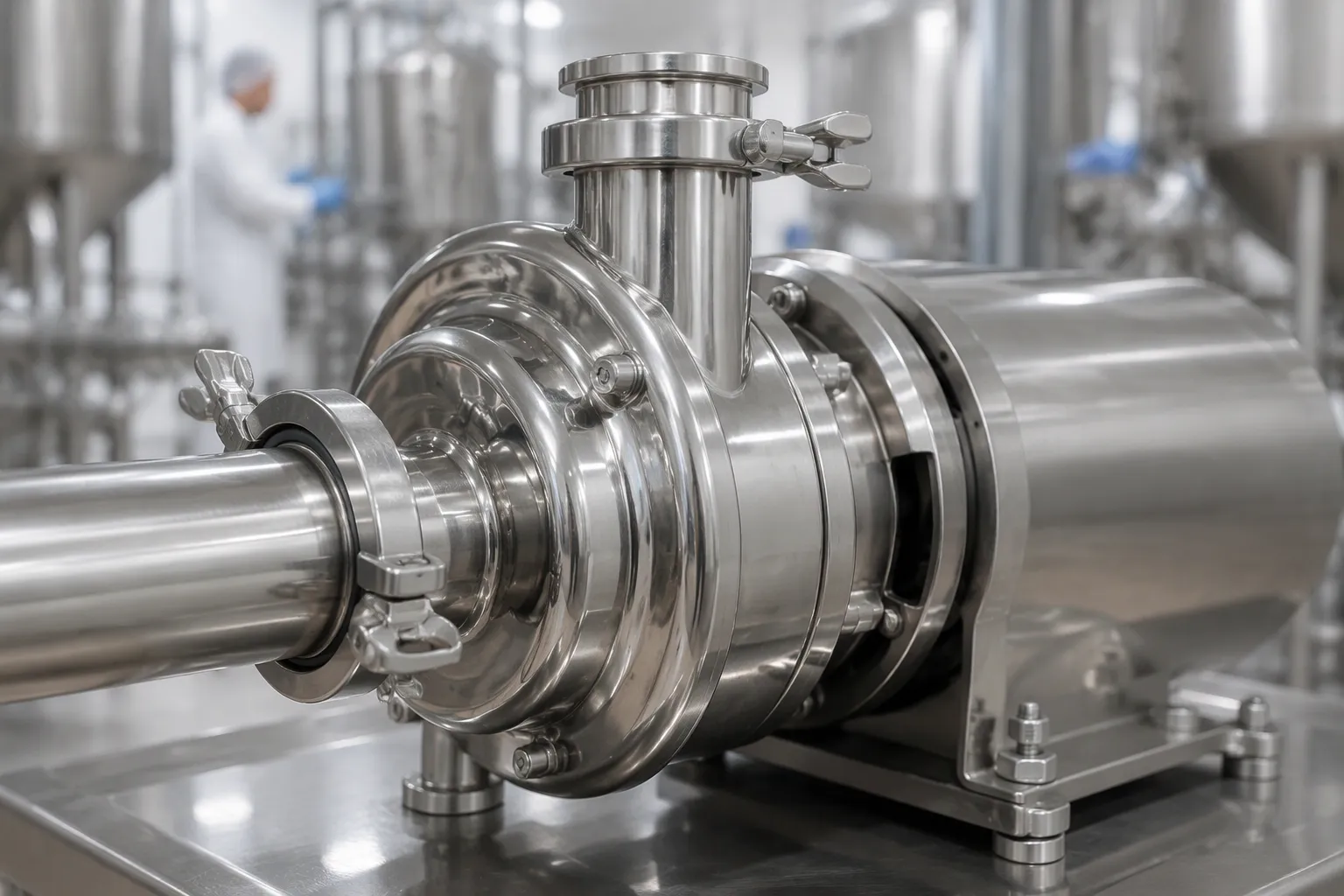
A sanitary ISO 2037 centrifugal pump is a clean pump whose connections match the ISO 2037 standard for stainless steel tubing and fittings. It moves food, dairy, beverage, and pharmaceutical products without contamination risk. An impeller spins inside the pump and throws liquid outward. The casing then turns that speed into pressure and flow.
This guide explains the main parts, the ISO 2037 standard, and the sanitary design features that support clean-in-place operation. It also covers common uses and compares centrifugal pumps with other sanitary choices.
Key Takeaways
A sanitary ISO 2037 centrifugal pump moves liquids without contamination and connects directly to ISO 2037 piping.
The pump uses a spinning impeller and a casing to make flow and pressure for clean transfer.
The parts that touch the product are made of 316L stainless steel with smooth finishes. This keeps products pure and easy to clean.
These pumps work best for fluids that flow easily and move in large amounts, such as milk, beer, and juice in food and drug plants.
Pick a diaphragm pump for thick products or ones that break apart easily. Centrifugal pumps cost less and use less energy for thin liquids.
What Is a Sanitary ISO 2037 Pump?
Definition and Core Purpose
A sanitary ISO 2037 pump is a clean centrifugal pump made to the ISO 2037 standard for stainless steel tubing and fittings. Food, dairy, beverage, and pharmaceutical plants use this design to move product through clean piping. The pump hooks up straight to ISO 2037 lines, so the process stays closed and safe.
Sanitary centrifugal pumps are the most common pump type in the sanitary industry. They keep product pure and carry no risk of contamination. The smooth inside has no crevices, so residues cannot collect. Operators can clean the pump in place instead of taking it apart.
Key Components and Functions
Each part of the pump head has a clear job in flow, hygiene, or sealing. The table below lists the main parts and what each one does.
Part
Configuration
Function
Semi-open impeller
100 mm
Throws liquid outward; tight tolerances limit internal recirculation and support high efficiency
Casing and wetted metal parts
AISI 316L
Holds the liquid and gives a clean stainless-steel contact surface
Shaft with pin
Sized for 0.75–1.1 kW motors
Carries motor torque to the impeller
Mechanical shaft seal
Single, SiC / SiC
Seals the shaft opening; both faces are silicon carbide
Elastomers and O-rings
EPDM
Seal joints; EPDM handles media from −10 to +140 °C
Clamp connections
ISO 2037, inlet 51 mm (2") and outlet 38 mm (1½")
Join the pump to clean piping without adapters
The impeller diameter sets part of the performance range for a given setup. The casing material and the seal faces protect product contact and shaft sealing. The EPDM elastomers work with many media and cleaning routines, and the operator picks them for the specific duty. Clamp rings hold the casing together and allow quick access during maintenance.
How Centrifugal Pumps Work
Impeller, Casing, Shaft, and Seal
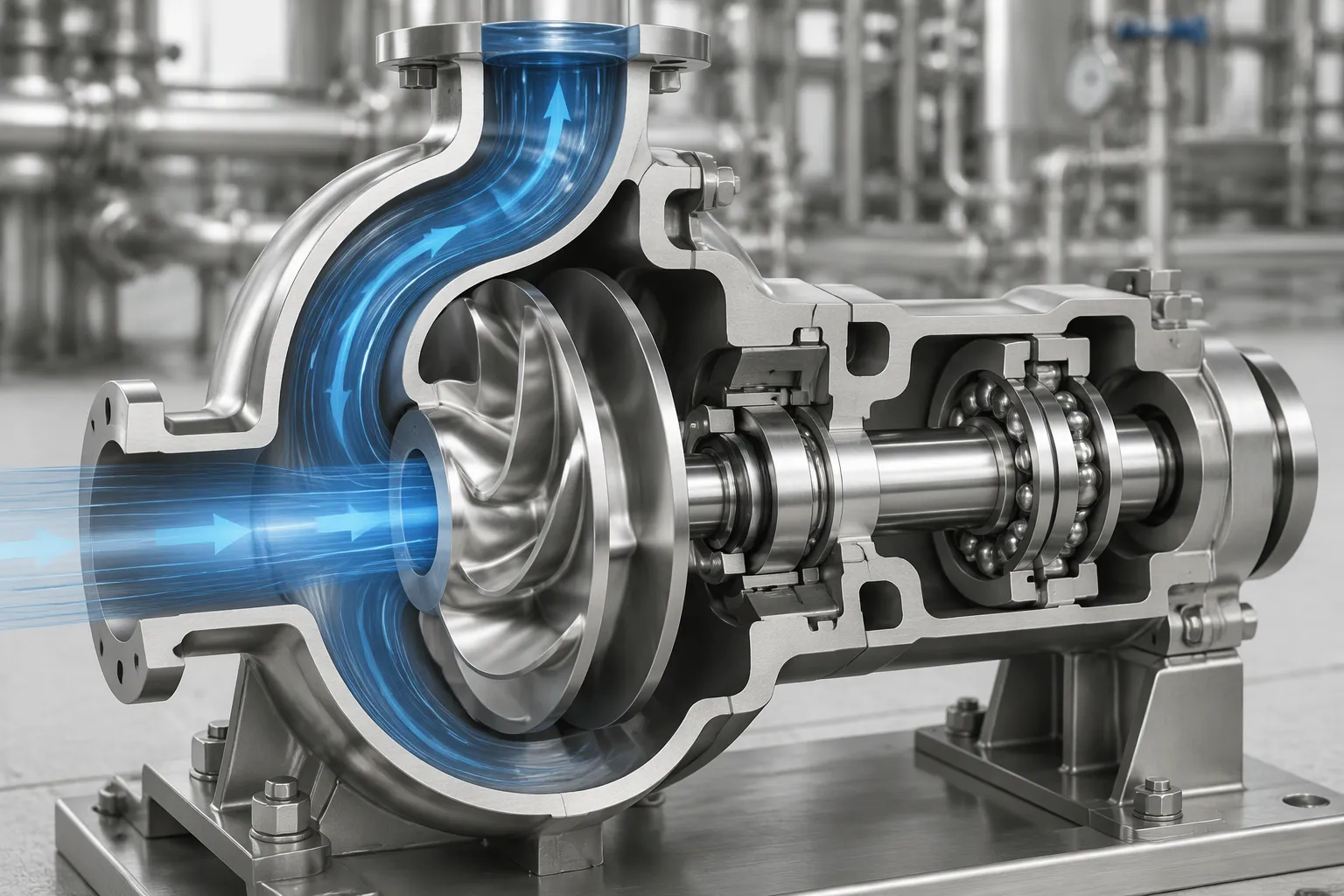
The centrifugal principle is easy to grasp. A spinning impeller flings liquid against the outer casing wall. The casing then changes that spinning energy into flow and pressure. The parts that make this happen follow a clear order:
The motor makes rotational torque.
The coupling passes that torque to the shaft.
The shaft, held by bearings, spins the impeller.
The impeller pulls fluid in at the eye and pushes it outward through the vane passages, adding kinetic energy.
The casing volute gathers the fast-moving fluid and turns its speed into pressure.
Wear rings limit internal recirculation losses.
The mechanical seal stops fluid from leaking along the shaft.
Pressurized fluid leaves through the discharge nozzle and enters the process line.
Each part has its own job. The impeller is the rotating element that adds energy to the fluid. The casing is the stationary shell that holds pressure and turns velocity into head. The shaft works as the mechanical spine, and it must handle twisting loads, bending loads from the impeller weight, and axial thrust from pressure differences across the impeller faces. The mechanical seal uses two lapped flat faces, one rotating and one stationary, held together by spring force and lubricated by a thin film of product or flush fluid.
Operators control flow in two main ways. They can throttle a valve on the discharge side, or they can change the impeller speed with a variable-frequency drive. Speed control works well for processes with changing flow rates, because the pump follows demand instead of fighting a partly closed valve.
Some models handle tougher jobs. Liquid-ring centrifugal pumps move liquids with trapped air or gas, and they work great in CIP return service. One such design pumps at 90 gallons (340 liters) per minute, uses 316L stainless steel for all product-contact parts, carries a 32Ra finish, and meets 3-A sanitary standard #36-01. These units also self-prime, so they empty drums, totes, and tanks with a single direction capability.
Flow Path and Cleanability
Fluid enters the impeller eye axially and leaves radially at high speed. That path shapes both performance and hygiene. A smooth, open route from suction to discharge leaves few places for residue to settle. Radial-flow designs deliver high head at low to moderate flow, which suits transfer duties in hygienic plants.
Cleanability depends on that same geometry. The flow path arrows show how fluid sweeps from the eye outward, gaining speed and pressure along the way. A cleaning cycle must reach the casing, the suction strainer, and the impeller. Maintenance checks cover impeller wear or damage and leak inspection at the seal area. A pump with clamp connections opens quickly for these tasks, and its interior drains fully so cleaning fluid reaches every wetted surface.
Sanitary Design and ISO 2037
Materials and Surface Finish
Keeping things clean starts with the metal that touches the product. The wetted parts on these pumps are made of AISI 316L stainless steel. This type of steel fights off rust from cleaning chemicals and acids in the product. It also lasts through many washdown cycles. The casing, impeller, and other product-contact surfaces all use this same material. That way, the whole wetted path acts the same.
The surface finish is just as important as the metal. A rough surface catches leftover product and gives bacteria a spot to grow. Sanitary pumps usually have a polished finish on all wetted surfaces. Some models reach a 32Ra finish, which is a roughness value that helps keep things clean in dairy and pharmaceutical work. Smooth surfaces also cut down on friction losses and help the pump drain all the way after cleaning.
Elastomers finish the wetted picture. EPDM O-rings and gaskets seal the joints between casing parts. EPDM works with media from −10 to +140 °C, so it handles cold dairy lines and hot CIP cycles alike. The operator picks the elastomer for the specific job. The seal material must match both the product and the cleaning chemicals.
Hygienic Connections and CIP
ISO 2037 sets the sizes and tolerances for stainless steel tubes and fittings. A pump made to this standard connects right to ISO 2037 hygienic piping without adapters. That direct fit removes extra joints. Every extra joint is a possible leak point or a spot where residue can hide. The clamp connections on a typical unit measure 51 mm (2") at the inlet and 38 mm (1½") at the outlet. Clamp rings hold the assembly together so you can get to it fast.
Clean-in-place support is what makes sanitary pumps different from general industrial models. CIP lets the plant clean and sanitize the pump inside without taking it apart. Cleaning fluid flows through the casing, over the impeller, and out the discharge. It sweeps every wetted surface as it goes. The open flow path and smooth finish make this sweep work well. Operators then put the pump back to work without opening the head.
Piping flexibility matters in real plants, where lines may follow different standards. ISO 2037 hygienic pumps often come with connections that also support DIN and SMS standards. A plant with mixed piping can order the connection that matches each line. The table below sums up the common options.
Connection Standard
Typical Use
Adapter Needed for ISO 2037 Line?
ISO 2037
Direct fit to ISO 2037 hygienic tubing
No
DIN
Plants built to DIN hygienic piping
Yes, unless the pump is ordered with DIN ends
SMS
Plants built to SMS hygienic piping
Yes, unless the pump is ordered with SMS ends
Buyers should check the connection standard before they order. A pump with the wrong ends forces adapters into the line. Adapters add cost, cleaning work, and failure points. Matching the pump to the plant's piping standard keeps the process closed and the cleaning routine simple.
Typical Applications
Food, Beverage, and Pharmaceutical Uses
Sanitary centrifugal pumps move many kinds of products through clean pipes. Common examples are water, wine, beer, soft drinks, milk, and cleaning solutions. The gentle flow path keeps product quality safe during transfer. Plants depend on this design for daily production and for washdown routines.
Dairy plants pump milk, cream, and yogurt with these units. Beverage lines move juices, soda, flavored waters, teas, and energy drinks. Brewing and fermentation systems use them to move wort and finished beer. Food processors handle sauces and dressings, and pharmaceutical plants move liquid ingredients for production. The clean design and high-efficiency flow work well for food-grade fluids without harming the product.
Where This Pump Fits Best
These pumps work best in jobs that need high flow rates and moderate pressure. They handle low-viscosity fluids best, so juices, concentrates, beer, and wine move at different rates to meet capacity needs. Adjustable pump speeds give a low-cost way to control flow. Operators just change the speed instead of throttling a valve.
Clean-in-place operation is another good fit. Many sanitary centrifugal pumps serve as CIP pumps in clean-in-place setups. The pump cleans itself without taking it apart, and all product contact areas get sanitized automatically. Plants also use the same units to circulate cleaning agents through the system.
Small and medium process jobs in the dairy, food, beverage, and pharmaceutical industries match this pump well. The simple design, versatility, and efficiency explain why centrifugal pumps are the most common sanitary pump type. They reach a high flow rate at fairly low pressures, which suits transfer jobs rather than high-pressure process work. A plant with steady, high-volume hygienic transfer needs will find this pump a natural fit.
Comparison With Other Sanitary Pumps
Centrifugal Pumps vs. Diaphragm Pumps
Sanitary diaphragm pumps are part of the positive displacement family. They trap a set amount of fluid and push it forward with each stroke. This design gives a nearly steady flow no matter what the pressure is. A centrifugal pump works in a different way. Its flow changes when discharge pressure changes, so the duty point is important.
The two designs also react in opposite ways to viscosity. A centrifugal unit loses flow as viscosity goes up, and friction losses drag efficiency down. A diaphragm pump gains flow as viscosity goes up, and its efficiency gets better with thicker media. Seal life is better with the diaphragm design, because it runs at lower speed. Pressure capability also favors positive displacement models, which usually make more pressure than centrifugal pumps.
Each design fits a different job. Centrifugal models are great for moving low-viscosity fluids at a steady rate in high volume. Diaphragm models do best with viscous, abrasive, or corrosive fluids, and they handle solids and gases inside the fluid. A plant that moves milk or beer all day leans toward the centrifugal option. A plant that doses thick sauce or slurry leans toward the diaphragm option.
Cost tells a similar story. A centrifugal unit costs less upfront, about $200 to $1,000, while a diaphragm unit runs $500 to $3,000 or more. The diaphragm pump makes up for that price with better tolerance for harsh duty, which cuts downtime and replacement expenses. Both types meet hygienic standards when built with 316L wetted parts, suitable finishes, and CIP support.
Energy use gives centrifugal designs a general edge in hygienic work. They move large volumes nonstop with high efficiency, and variable speed control matches flow to demand. Diaphragm pumps use more energy per gallon because of their reciprocating action. Buyers should match the pump type to the duty, then confirm the compliance details for the chosen model.
A sanitary ISO 2037 centrifugal pump uses a spinning impeller to push liquid outward. The casing then turns that motion into pressure and flow. The pump gets its sanitary rating from 316L stainless steel wetted parts and polished surfaces. It also has adapter-free ISO 2037 clamp connections and full clean-in-place support.
These units work best for high-flow, low-viscosity transfer jobs. You will find them in dairy, beverage, food, and pharmaceutical plants. Diaphragm pumps are still the better pick for viscous or shear-sensitive media. Each design serves its own duty well.
Engineers and procurement specialists should check the piping standard and elastomer choice before ordering. A pump that matches the line and the product keeps cleaning simple and production steady.
FAQ
What does the ISO 2037 designation mean on a sanitary pump?
ISO 2037 sets the sizes and tolerances for stainless steel hygienic tubing and fittings. A pump built to this standard connects straight to matching pipe with no adapter. That direct fit removes extra joints where residue could collect or leaks could start.
Can the pump be cleaned without taking it apart?
Yes. Clean-in-place support lets cleaning fluid flow through the casing, across the impeller, and out the discharge. The fluid sweeps every wetted surface along the open flow path. Operators then put the unit back to work without opening the pump head.
Which materials and finish make the pump sanitary?
All wetted parts use AISI 316L stainless steel, which resists corrosion from cleaning chemicals and product acids. Wetted surfaces have a polished finish, and some models reach 32Ra. EPDM seals handle media from −10 to +140 °C, covering cold product lines and hot cleaning cycles.
What fluids suit this pump, and what fluids do not?
Low-viscosity fluids fit best: water, milk, beer, wine, juice, and cleaning solutions. Flow and efficiency drop as viscosity rises. Thick sauces, slurries, and shear-sensitive media need a positive displacement design instead.
How does a buyer choose between centrifugal and diaphragm designs?
Match the pump to the duty. Centrifugal units cost roughly $200 to $1,000 and work best for high-flow, low-viscosity transfer. Diaphragm units run $500 to $3,000 or more and handle viscous, abrasive, or shear-sensitive media. Both meet hygienic standards when built with 316L parts, suitable finishes, and CIP support.