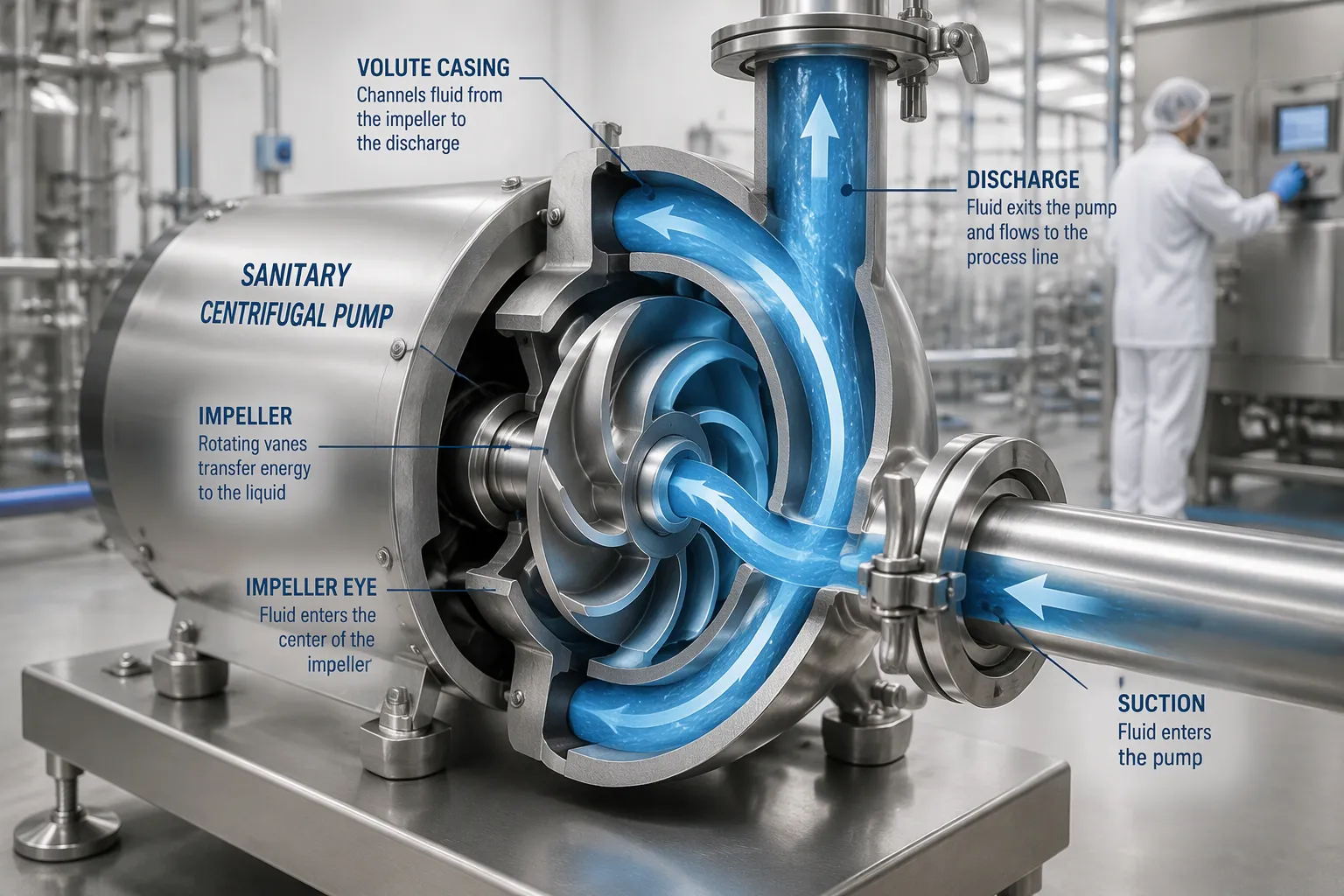
An Ampco sanitary centrifugal pump is a clean pump built to move food, drink, dairy, and drug products gently. It keeps product quality high during transfer.
This article explains how the pump works, its main parts, where processors use it, and what to think about when choosing one. Readers will learn the basic ideas behind the design and the factors that help guide a smart choice.
Key Takeaways
An Ampco sanitary centrifugal pump gently moves thin, clean liquids to protect product quality.
The spinning impeller makes the flow, and the casing turns speed into pressure.
Sanitary design features, like stainless steel and smooth surfaces, make cleaning easy and help prevent contamination.
These pumps help the food, beverage, dairy, and pharmaceutical industries move products safely and efficiently.
Pick the right pump series for the best results. Base your choice on how thick the liquid is, how fast it flows, and how easily it is damaged by shear.
What Is an Ampco Sanitary Centrifugal Pump
Definition and Purpose
An Ampco sanitary centrifugal pump moves liquid products through a processing line and protects product quality. The design keeps the liquid clean and handles it gently. This pump type serves companies that need to move thin liquids at steady, high flow rates.
Ampco Pumps Company builds several centrifugal series, including the AC, L, SP, M, and D Series. These pumps work best in liquid applications where gentle product handling is a must. Beverage makers, dairy processors, candy producers, and similar industries often buy them. The pump's purpose is simple: move product from one point to another without harming texture, flavor, or composition.
Sanitary construction makes these pumps different from standard industrial models. Product-contact surfaces use stainless steel and smooth finishes. This design stops bacteria from collecting and makes cleaning easier between production runs. A processor who fills juice bottles or pasteurizes milk depends on this level of hygiene.
Centrifugal vs. Positive Displacement
Ampco offers both sanitary centrifugal and positive displacement pumps. Each type fits a different job. The centrifugal type fits best when the liquid flows easily and the process needs a steady, high-volume transfer. Positive displacement pumps handle thicker products, such as peanut butter or tomato paste, where the liquid resists flow.
Centrifugal pumps are widely used for relatively low-viscosity liquids where steady, high-flow transfer is required. A sanitary centrifugal pump suits liquids with a viscosity of up to 200 centipoises (cP). Common applications include:
Water and rinse solutions
Milk and other fluid dairy products
Thin beverages
Cleaning solutions
Low-viscosity liquid ingredients
A reader can think of viscosity as a liquid's thickness. Water is thin and flows fast. Honey is thick and flows slowly. The 200 cP limit marks the upper edge for this pump style. Above that point, a positive displacement pump usually does a better job.
The difference matters during equipment selection. A plant manager who chooses a centrifugal pump for a thin beverage gets efficient, gentle transfer. The same manager who tries to move a thick syrup with that pump may see poor performance. Matching pump type to liquid viscosity is the first step in a smart decision.
An Ampco sanitary centrifugal pump therefore serves a clear role in processing. It handles thin, clean liquids at high flow. It protects product quality through gentle action. It meets hygiene standards through sanitary materials and smooth surfaces. Readers who understand this role can move on to learn how the pump creates flow inside its casing.
How an Ampco Sanitary Centrifugal Pump Works
Impeller and Casing Action
The impeller is the moving part at the center of the pump. It connects to the pump shaft and spins with it inside a casing that does not move. The casing wraps around the impeller and holds the liquid during transfer. Liquid comes in through the suction port and reaches the eye, or center, of the impeller. The spinning vanes catch the liquid and push it outward toward the casing wall. This action gives the liquid speed and starts it on its way to the discharge.
The shape of the casing matters as much as the impeller. A volute casing is a spiral chamber that gets wider toward the outlet. The widening slows the fast-moving liquid and turns its speed into pressure. A diffuser casing does the same job with vanes that do not move instead of a spiral. Either design guides the liquid to the discharge port and out into the piping system. Smooth inside surfaces also help the pump run clean and make cleaning between runs easier.
Tight manufacturing tolerances keep this action working well. The Ampco SP Series self-priming liquid ring pump shows how far this idea can go. It handles products with trapped air and CIP return jobs while keeping the performance and efficiency levels it is rated for. Its tight tolerances and special vane-shaped, or wagon wheel style, impeller let it empty tanks and drums efficiently. The same design handles shear-sensitive products gently while keeping peak pump performance. A processor who empties a drum therefore gets fast, complete transfer without harming the product.
Flow and Pressure Creation
A centrifugal pump adds speed to the liquid with a spinning impeller. The volute then turns that speed into pressure. This two-step energy transfer explains almost everything about how the pump behaves.
The motor turns the shaft, and the shaft turns the impeller. Mechanical energy leaves the motor and enters the fluid. Part of that energy becomes kinetic energy, the energy of motion. Part becomes potential energy, which shows up as fluid pressure or as lift against gravity. Engineers often describe the transfer in terms of centrifugal force. The outlet pressure reflects the pressure that applies centripetal force.
The flow path follows a clear order:
Liquid enters the suction port and moves to the impeller inlet.
The rotating impeller carries the liquid along its spinning vanes and raises its speed.
The liquid leaves the vanes and enters the volute or diffuser casing.
The casing turns high speed into high pressure through diffusion.
The liquid exits the discharge port and travels into the system.
Flow and pressure stay linked for a given pump size and shaft speed. Higher pressure comes only at lower flow. The impeller can generate just so much speed, and the clearance between impeller and volute adds losses. A user who understands this tradeoff can read a pump curve with confidence. The same knowledge helps explain why an ampco sanitary centrifugal pump suits thin liquids at steady, high flow. Operators use this relationship when they set valve positions and pick impeller trims for a duty point. Gentle handling and efficient transfer come from this simple, reliable principle.
Key Components and Hygienic Design
Impeller, Casing, and Seals
The impeller, casing, and seals are the main parts of any ampco sanitary centrifugal pump. The impeller turns and pushes the liquid along. The casing holds the liquid and sends it to the discharge. Seals keep the product inside the pump and block outside dirt from getting in. Every part must follow strict hygiene rules because the product touches these surfaces directly.
The AC Series uses a close-coupled design. This setup joins a power/drive section with a liquid end/pump section. The motor hooks right to the pump with no separate coupling guard. This compact build saves floor space and makes alignment easier. Maintenance crews can reach the liquid end fast for inspection or cleaning.
The K Series takes sanitary performance even further. Ampco makes this series from 316L stainless steel. That material fights corrosion and holds up to repeated washdowns. The table below shows the main features of the K Series.
Feature
Description
Material
316L stainless steel
Components
Precision-machined parts
Design
Sanitary construction
Performance
Capacities up to 200 GPM and pressures to 200 feet of head
Flow
Smooth, consistent delivery
Maintenance
Low upkeep needs
Construction
Robust build
Parts
Interchangeable components
Dimensions
Industry-standard sizes for quick installation
Applications
Beverage, dairy, food, and pharmaceutical processing
Connections and Cleanability
Connections decide how easily a pump comes apart for cleaning. Sanitary pumps use clamp fittings, threaded unions, or flange connections. Each type makes a smooth joint with no crevices. Smooth joints stop product from collecting in gaps where bacteria can grow. A processor who takes the pump apart for a clean-in-place cycle values this design.
Cleanability depends on surface finish and drainability. Product-contact surfaces get a polished finish that sheds residue. The pump also drains all the way so no liquid pools inside after a run. The K Series meets this goal through its sanitary design and precision-machined components. Its industry-standard dimensions let crews swap it into existing lines without custom piping. Interchangeable parts also cut downtime because technicians replace worn pieces instead of the whole unit. These traits make the K Series a dependable choice for beverage, dairy, food, and pharmaceutical work.
Common Applications in Sanitary Processing
Food, Beverage, and Dairy
Food and drink factories are the biggest users of this type of pump. A centrifugal pump moves liquid using an impeller that spins very fast. This basic design gives a steady flow, so milk, juices, wine, and cleaning liquids move fast and stay clean. The sanitary design allows clean-in-place (CIP) cleaning and steam-in-place (SIP) sterilization without taking the pump apart. The inside shape has no dead spots where product can collect. Stainless steel bodies with smooth inner surfaces fight rust and lower the risk of contamination. Many models meet 3-A, EHEDG, and FDA rules for safe processing.
The AC/AC+ Series gives plants a low-cost choice for many different jobs. Parts that touch the product use 316L stainless steel, and the pump holds 3A certification for sanitary use. Crews get easy upkeep, dependable service, and long life at a fair price. The LC Series goes a different way. Thick wall construction adds strength, and the design fits gentle and efficient drink and dairy work. A dairy line that moves milk softly or a bottler that runs juice at steady flow finds a good match in one of these series.
Pharmaceutical and Personal Care
Drug makers and personal care companies need the same clean standards as food plants. An ampco sanitary centrifugal pump meets those needs with smooth product-contact surfaces and inner geometry that drains fully. CIP and SIP capability lets crews sanitize the pump in place between batches. Stainless steel construction helps with deep cleaning and cuts downtime between production runs. These traits matter when a line switches products often or must prove cleanliness.
Thin liquids are the main focus here. Syrups, liquid ingredients, alcohol-based solutions, and rinse water all fall in the low-to-medium viscosity range where centrifugal action works best. The pump moves these fluids at high flow rates for continuous processing. Small bits, like those in protein drinks, also pass through with the right impeller and seal choices. Processors who match pump series to their job get efficient transfer and reliable hygiene.
Choosing the Right Ampco Pump
Sizing and Performance Factors
Three things help you pick an ampco sanitary centrifugal pump: viscosity, flow rate, and shear sensitivity. Viscosity is how thick a liquid is. Centrifugal models work well with thin liquids, and the L Series handles gentle work up to 1200 cP. If you move a thicker product, check this limit before you choose a model.
Flow rate sets how much liquid the line needs each hour. Shear sensitivity matters too. Some products, like certain drinks and dairy items, lose texture when a pump is too rough on them. A gentle impeller and tight tolerances protect these products. The SP Series works for emptying tanks and drums and for shear-sensitive jobs. The AC/AC+ Series gives you a low-cost choice for everyday use. The K Series adds 316L stainless steel durability. The LC Series uses heavy wall construction for gentle drink and dairy work. Each series fits a certain job, so matching the pump to the duty point gives the best result.
Materials and Design Options
The way a pump is built affects hygiene, seal life, and how long it lasts. The L Series uses heavy wall cast and machined 316L stainless steel, 304 stainless steel adapters, and a self-aligning shaft that makes seals last longer. Balanced impellers and tight tolerances boost efficiency. All L Series models can be fully cleaned in place (CIP).
Buyers also pick seals, finishes, and motor mounts. Surface finishes range from 32 RA to 12 RA. Seal choices include single or double internal seals in different materials. Pumps come close-coupled to NEMA standard JM motors. A modified M Series handles hot oil over 400°F (204°C) with Type 1 seals, Aflas elastomers, and ceramic coated sleeves. The AC line gives you low cost, 316L construction, and full interchangeability with other leading brands.
An ampco sanitary centrifugal pump moves thin, clean liquids using a spinning impeller inside a casing that stays still. The impeller adds speed, and the casing changes that speed into pressure.
The impeller, casing, and seals make up the main parts of the design. Processors use these pumps for drinks, dairy, food, and drug products. Thickness, flow rate, and how easily a liquid breaks down guide the choice among the AC, SP, K, and LC Series. Each series fits a certain job, and 316L stainless steel build helps the pump last a long time.
Clean processing rules will keep getting stricter. This pump will stay a trusted tool for guarding product quality on the line.
FAQ
What liquids suit an Ampco sanitary centrifugal pump?
Thin, clean liquids work best. The pump handles products up to about 200 cP, which measures thickness. Water, milk, juice, and rinse solutions all fit this range. Thicker products like peanut butter need a positive displacement pump instead.
How does the SP Series differ from other models?
The SP Series is a self-priming liquid ring pump. It clears trapped air and empties tanks and drums well. Its wagon wheel style impeller and tight tolerances handle shear-sensitive products gently. Other series focus on different jobs, such as economical transfer or heavy wall construction.
Which series fits a tight budget?
The AC/AC+ Series gives plants a low-cost option for many jobs. Product-contact parts use 316L stainless steel, and the pump holds 3A certification. Crews get easy upkeep and long service life at a fair price. It also swaps directly with other leading brands.
What surface finishes and seals can buyers choose?
Surface finishes range from 32 RA to 12 RA. Seal choices include single or double internal seals in different materials. Pumps come close-coupled to NEMA standard JM motors. A modified M Series handles hot oil over 400°F with Type 1 seals and Aflas elastomers.
Can crews clean the pump without taking it apart?
Yes. These pumps support clean-in-place (CIP) and steam-in-place (SIP) cleaning. Smooth product-contact surfaces and full drainability leave no dead spots where residue collects. Many models also meet 3-A and EHEDG rules for sanitary processing.