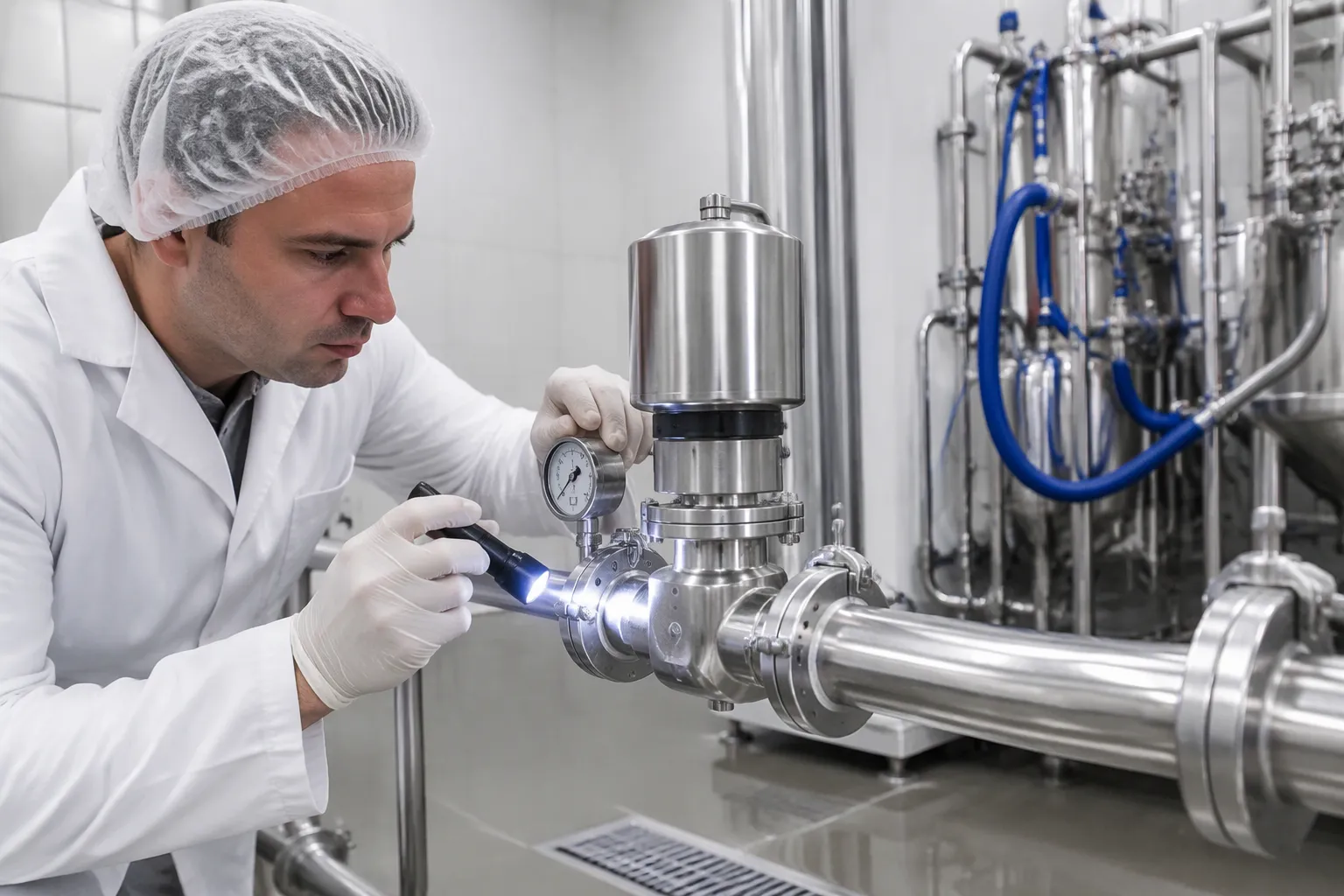
Sanitary flow control valves control how fast liquid moves through clean processing systems without letting germs get into the product. These valves give exact flow control while keeping the inside passages free of spots where dirt can hide. Smooth, gap-free shapes and highly polished stainless steel surfaces stop organic material from sticking to the metal, and the parts that touch the product meet FDA and 3-A material standards. Food processing lines, beverage manufacturing, dairy operations, and pharmaceutical facilities all depend on sanitary valves to separate, redirect, or adjust flow. A sanitary valve works well in clean fluid systems where cleanliness matters as much as accurate control.
Key Takeaways
Sanitary valves use smooth stainless steel and gap-free designs to keep germs out of food and medicine lines.
These valves control flow by changing the size of the passage. Some of them use air pressure to make smooth adjustments.
Pick a valve based on the fluid, the cleaning needs, and the certifications you require. This helps ensure safety and compliance.
Cleaning and checking the valves on a regular basis stops leaks and contamination. This saves money on repairs.
Pick the right valve for the task: check valves stop water from flowing backward, while control valves manage how fast the flow moves.
Sanitary Valve Design Basics
Definition and Hygienic Features
A sanitary flow control valve is a valve made to control flow rate in a clean line while keeping every surface that touches the product easy to clean. Clean construction matters because bacteria need a place to hold on. Rough welds, threaded fittings, still water, and dead legs all give microbes a spot to settle, and a poorly finished surface turns a little residue into a growing biofilm. A hygienic flow control valve gets rid of those chances at the design stage.
Material choice does much of that job. Parts that touch the product usually use 316 stainless steel with PTFE seats; on two-way V-3N and V-3NM models the body is cast as CF8M, the cast form of 316, and 304 (CF8) bodies are available on request. Food plants like 316 over 304 because chlorides cause pitting and the molybdenum in 316 resists it better. Surface finish follows the same idea. The standard finish is a polished sanitary finish, and hygienic valves often hold Ra ≤ 0.8 μm, sometimes Ra ≤ 0.4 μm, while industrial valves rarely control roughness this tightly.
Design Feature
Specification
Materials
316 stainless steel with PTFE seats; CF8M cast body; 304 (CF8) on request
Surface finish
Polished sanitary finish
Cleanability
Fully encapsulated PTFE seats with no cavity behind the ball; three-piece body allows in-place seat inspection
Temperature limits
Fully encapsulated PTFE seat for lines at or below +80 °C; semi-encapsulated graphite seat to +180 °C, including steam
End connections
Tri-Clamp or OD-tube weld ends; extended weld ends keep heat away from PTFE seats
These clean design features help with easy cleaning and sterilization. Smooth sanitary welds remove cracks and crevices, correct slopes make sure everything drains, and CIP-friendly layouts let cleaning solutions reach every surface. Electropolished stainless steel also resists microbes sticking to it.
Dead-Leg-Free Flow Channel Design
Dead-leg-free flow channel designs keep liquid moving through the whole passage, so no pocket of product sits long enough to become a home for germs. A dead-leg-free flow channel design pairs a straight flow path with few cavities and gasket grooves shaped to avoid shadow areas. Zero-dead-leg valve designs go further by adding full drainability with no hidden spaces where bacteria could grow.
Drainability completes the picture. Standing liquid creates cleaning and contamination problems, so lines should slope correctly where gravity drainage is expected, and low points need proper drains. A three-piece body helps here too: the center section and ball come out of the line without cutting the tube, so seats can be checked or replaced in place for clean-out-of-place duty.
Standard industrial valves do a different job well. They focus on strength and durability for dirty fluids, slurries, and corrosive chemicals at extreme pressure and temperature, and they accept dead zones because hygiene is not the goal. Sanitary valve design fits food, beverage, dairy, and pharmaceutical lines where cleanability and audit compliance drive the specification. Each style suits its own service, and matching the valve to the process is still the deciding factor.
How Sanitary Flow Control Valves Work
Flow Regulation Mechanism
A control valve changes the size of the fluid passageway to control flow, pressure, or other process parameters tied to flow. An operator or an automatic positioner moves the valve trim, and that movement changes the percent open of the valve. The cross-sectional area of the pathway grows or shrinks, and the flow rate follows. Different valve designs produce different flow curves for percent open versus flow rate, so two valves at the same opening may pass different amounts of liquid.
Dome-loaded designs take a different route. A supple diaphragm moves up and down to adjust flow rate. Pressurized pilot gas, usually air, pushes on the top of the diaphragm to hold the process setpoint. Raising the pilot pressure decreases flow, and lowering it increases flow. This arrangement gives smooth, repeatable flow control in hygienic lines.
Components and Control
Every sanitary valve shares a few core parts. Each part plays a clear role in safe, accurate operation.
Body – the outer shell that holds the internal parts and directs fluid flow.
Bonnet – a removable cover that seals the valve and allows access for maintenance.
Trim – the internal elements that control and seal flow, including the seat, the disc, the stem, and the stem packing.
The trim matters most. Most differences between sanitary valves come down to the trim rather than the body or bonnet. A sanitary valve body provides the fluid connections and a movable restrictor made of a stem and plug. That restrictor touches the fluid and varies the flow. Pneumatic sanitary valves add an actuator that drives the stem, and the actuator works with the positioner to hold a set opening.
Backflow prevention and cleaning support are separate jobs. Check valves stop reverse flow and keep movement one-way, which suits clean water and sterile systems. Mix-proof valves let two products pass at once without mixing, a natural fit for CIP processes. Air blow check valves can also block a supply pump from running backward between CIP step functions. Clogged lines, blocked check valves, damaged components, or parts stuck open or closed all cause CIP flow problems. A dead-leg-free flow channel design and crevice-free interiors with polished surfaces keep CIP/SIP cleaning effective, and corrosion-resistant stainless steel stays compatible with CIP/SIP systems. Together these features support hygienic flow control across the whole line.
Main Sanitary Valves and Applications
Check and Ball-Type Check Valves
A two-port sanitary check valve lets fluid come in through an inlet and go out through an outlet in just one direction. The valve opens at cracking pressure, which is the lowest pressure difference that lifts the disc off its seat. Back pressure at the outlet pushes the disc back down at reseal pressure and stops reverse flow. These valves work on their own, with no operator or outside control, so they keep upstream equipment safe from backflow contamination. Sanitary valves like this use 304 or 316 stainless steel contact parts with smooth, polished surfaces and no crevices, which works well for dairy, food, and pharmaceutical lines.
Ball-type check valves use a ball that lifts off its seat during forward flow and drops back to seal when flow stops. The ball turns as it cycles, which gives a wiping, self-cleaning action against the seat. In a Y-shaped body, the ball moves into the larger chamber and away from the main path, so pressure drop stays low during high-flow conditions. That matters during CIP/SIP cleaning, where cleaning depends on enough flow speed. A solid PTFE ball also avoids the delamination risk of elastomer-covered designs.
Angle and Globe Control Valves
Angle seat valves work well for beverage jobs such as KEG cleaning and bottling plants, and they do well at small nominal sizes and low operating pressures where tight shutoff matters. Globe, or seat, valves handle dosing of process gases and control of tank pressure or flow rate in bottling. Sterile versions serve product contact duties across beer, soft drinks, milk, yogurt with fillings, chocolate, cooking sauces, and condiments.
Other designs fill narrower roles. A sanitary diaphragm valve keeps fluid away from the valve mechanism, which makes sanitary diaphragm valves a good fit for sterile duty, and sanitary diaphragm valves also show up in water for injection (WFI) systems and aseptic liquid systems. A sanitary butterfly valve gives on/off control and can throttle flow, so a sanitary butterfly valve often serves pharmaceutical liquid transfer systems. Matching each type to its job keeps sanitary flow control valves reliable.
Selecting a Sanitary Valve
Performance and Application Fit
Matching a sanitary valve to the process starts with the fluid itself. Buyers list the chemical name, concentration, purity, suspended particles, corrosiveness, and viscosity. They also note the cleaning chemicals, because a seal that swells in caustic will fail long before the body does. Flow range comes next: required flow rate, flow coefficient (Cv), fluid velocity, pressure drop, and pipe diameter all shape the choice between full-port and reduced-port construction.
Parameter Category
Parameters to Consider
Media compatibility
Chemical name and concentration; purity; suspended particles; corrosiveness; viscosity; cleaning chemicals
Cleaning needs decide the finish. Standard sanitary systems usually accept 32Ra finishes, but validated high-purity fluid systems need smoother electropolished surfaces. A sanitary diaphragm valve cuts down crevices and trapped product, which suits aseptic and high-cleanliness processes and water for injection (WFI) systems. Teams learning how to choose the right sanitary valve should confirm CIP and SIP compatibility early, then check pressure, temperature, and elastomer limits.
Compliance and Cost
Regulatory fit narrows the field further. Food and dairy service points to FDA 21 CFR 177, 3-A SSI standards, and EHEDG hygienic design; pharmaceutical service adds ASME BPE, which specifies 316L stainless steel with a maximum carbon content of 0.035% and an electropolished SF4 finish of Ra ≤ 0.51 μm for WFI. Elastomers in drug-contact valves usually need USP Class VI biocompatibility, and EU projects look for EC 1935/2004 compliance.
Cost trade-offs deserve a neutral look. A sanitary butterfly valve costs less and handles on/off isolation well, while a sanitary diaphragm valve costs more and delivers enhanced cleanability. Pneumatic sanitary valves add automation cost but support repeatable control. Sanitary valves with full certification cost more upfront and reduce compliance risk later. The practical rule for how to choose the right sanitary valve: set material, structure, and certification compliance as the floor, then compare price.
Maintaining Sanitary Flow Control Valves
Routine Maintenance Practices
Regular care keeps a sanitary valve working right and staying clean. Operators begin by looking at the valve. They check for leaks or wet spots around the body, rust or mineral buildup, cracks you can see, and loose mounting hardware. They also make sure handles and actuators are tight and move easily. Then they test how it works: each valve should close all the way and open all the way, flush without stopping, and make no banging or extra noise. Technicians work every valve now and then and check that labels show what it controls.
Cleaning follows a set order. Cool water below 80°F rinses the lines first to remove heavy soil and stop protein from thickening. Next, the cleaner solution flows through long enough to strip away residue, and then a water rinse follows. A sanitizing step comes last, either a chemical rinse or hot water. Flow must stay turbulent, because turbulence gives the scrubbing action that cleans inside surfaces. The 3-A Accepted Practices for Permanently Installed Sanitary Product Pipelines and Cleaning Systems require a full physical break between cleaning and product circuits, or at least two automatic valves with a drainable opening between them. Loosening line connections during clean-in-place (CIP) sanitation cycles lets solution reach the gasket faces. Teams should also watch chemical concentration, pH, and temperature, and check results with ATP swabs. These habits keep CIP/SIP cleaning working well on every sanitary valve in the loop.
Troubleshooting Common Issues
Leaks are the number one problem. Internal leaks usually come from worn parts or an actuator that is out of adjustment. External leaks often come from packing, materials that don't work together, or vibration. Tightening the packing fixes small drips, but over-tightening makes the stem stick. Pressure gauges, flow monitoring, and acoustic sensors catch slow leaks before they get worse. Backflow means a check mechanism is dirty or worn, so technicians inspect the seat and disc and confirm reseal pressure. Restricted flow usually means debris, welding slag, or scale has reached the orifice. Putting a filter ahead of the valve and flushing the line after setup prevents most blockages. A sanitary diaphragm valve with a smooth, crevice-free interior resists buildup better than a complex path. A sanitary butterfly valve works for isolation duty, while sanitary diaphragm valves and other control styles handle throttling. No matter the design, scheduled inspection, correct installation torque, and compatible cleaning agents protect SIP sterilization results and extend service life.
Sanitary flow control valves control how fast liquid moves through clean processing lines. They change the size of the inside passage to adjust flow, while smooth, gap-free surfaces keep contamination out. Choosing the right valve and keeping up with steady maintenance decide whether a sanitary valve works as designed. A seat material that doesn't match or a wrong size invites leakage, wear, and cleaning gaps, while routine inspection catches worn seats and seals before they fail. Industry estimates put preventive maintenance savings at 30% to 40% over reactive repairs. Readers should match each sanitary valve to their own media, temperature, and hygiene standard, then keep that flow control choice checked through scheduled care.
FAQ
What makes a valve sanitary?
A sanitary valve uses 316 stainless steel contact parts, polished surfaces, and crevice-free internals. These features stop bacteria from settling and let cleaning solutions reach every surface. The design also drains fully, so no standing liquid remains after cleaning.
How does a buyer choose between a check valve and a control valve?
A check valve lets flow go one way and blocks backflow by itself. A control valve changes flow rate using an actuator or positioner. Buyers choose the check style for protection and the control style for regulation. Many lines use both sanitary valves together.
How often should a plant clean and inspect its valves?
Cleaning follows the line's CIP schedule, with a cool rinse, cleaner cycle, rinse, and sanitizing step. Inspection should happen at each scheduled shutdown. Operators check for leaks, loose hardware, and full open-and-close travel. ATP swabs confirm cleaning results.
What are the warning signs of a worn sanitary valve?
Drips at the packing, slow leaks, banging during operation, and flow that will not hold a setpoint all point to wear. A check mechanism that lets reverse flow pass needs seat and disc inspection. Early detection prevents contamination and extends service life.
Do sanitary valves need special certification for pharmaceutical use?
Yes. Drug-contact service often calls for ASME BPE construction, 316L stainless steel, and USP Class VI elastomers. Food and dairy lines typically follow FDA 21 CFR 177, 3-A SSI, and EHEDG guidance. Buyers should confirm the standard their process requires before ordering.